P2P Session: Speakers and Content Suggestions Wanted

In May, I’ve got a panel at Streaming Media East entitled "P2Ps Role In Delivering Online Video" and I am looking for speakers and suggestions on the content. What core topic or facet should the session really drill down on? What are the most pressing issues with P2P and who would make for good speakers?

At our last show, we did a whole P2P session with just vendors, so this year around I am looking to have speakers from non-vendor companies. Customers, ISPs, legal experts etc…. is the angle I am thinking of but am open to ideas. I am also looking for a really good moderator that is not employed by a P2P vendor.

Please leave content suggestions and topics in the comments section and contact me if you want to speak or know of a good speaker/moderator. Anyone who is helpful in securing speakers will receive a free conference pass to the event.

Sponsored by

CDN Survey Data: 52% Have No Commit Contracts, 63% Use One CDN Vendor

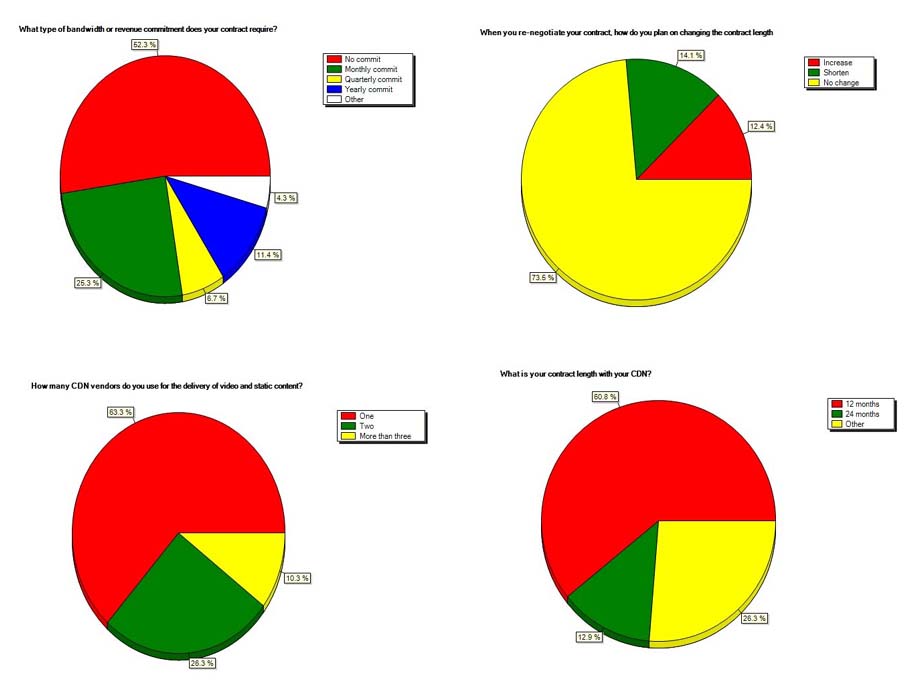
The StreamingMedia.com survey on CDN pricing and trends has now been filled out almost 1,000 times. I’ll be keeping it open for another week or so and then we’ll start to compile all the data and give away the free iPhone. Taking a look at some of the preliminary data that has been collected reveals some great data points which I will be showcasing all this week on the blog.

When it comes to the length of CDN contracts, customer commit levels and dual-vendor strategy, there has a been a lot of speculation in the market on what the trends are. Here is the data we collected from nearly 1,000 respondents, 25%+ of which are doing over 25TB of delivery per month.

  • 60.8% of respondents said they had a 12 month contract with their CDN. Only 12.9% had a two year deal.
  • 73.5% said that when they renegotiate their contract, they don’t plan
    to change the length. Only 12.4% said they planed to sign a longer term
    contract.
  • 52.3% of respondents said their CDN contract had no revenue or
    bandwidth commitment at all. 25.3% have a monthly commit, 6.7% a
    quarterly commit and 11.4% have a yearly commit.
  • 63.3% of respondents said they used only one CDN vendor for the
    delivery of video and static content. 26.% use two CDNs and 10.3% use
    three or more.

You can download the pie chart data for the questions here:(Download CDN-Contract-Data.jpg)

Job Opening: Media Delivery Sales Execs, Pando Networks

Pando Networks is currently looking to fill an immediate need for a Media Delivery Sales Executive located in NYC or LA. With nearly every major media company considering peer assisted delivery for long
form, high res content, this it’s a good opportunity for someone
who’s not afraid to sell into a developing market environment with an
emerging leader.

If you are interested, contact David at Pando Networks.

If you are looking for a new position, have taken a new job or are a
company that has a job opening, let me know. In many cases I will
highlight it here on the blog – free of charge.

DivX Finally Shuts Down Stage6 Portal

Images_2
Today, DivX announced that it would be shutting down the Stage6 video portal effective this Thursday. DivX originally planned to spin off Stage6 as a separate company late last year but then announced in December that it was looking for strategic alternatives instead.

I’m never pleased to see any service or video portal have to close but this is the best thing DivX could be doing. Operating a portal was not their core business and the last thing we need right now as an industry, or as consumers, is more video portals. Stage6 never got any real traction in the industry, was not a service I heard others discussing and had very little in the way of usage by content owners.

From the get go the service was destined to fail as DivX was using the site to showcase their own technology. The problem being that if the only way you can try to showcase adoption of your technology by content owners is by running your own website, it won’t work. The shut down notice on the Stage6 website says the service was started "with the mission of empowering content creators and viewers to discover a new kind of video experience." I’m not sure what that "new kind of video experience" was they are referencing but I think too many companies in the industry think that just because they encode video at high bitrates or large window sizes, they will be successful. You have to do more today than just deliver video that looks good, you have to have a business model behind it and their needs to be a demand for the service.

A high-quality, high-bitrate, large window sized video content offering does_not equal success by itself.

Microsoft Gives First Look At Silverlight 2 Functionality

Images_2
Last Friday, Scott Guthrie from Microsoft gave out details on his blog about the next version of Silverlight. Scott says that Microsoft will soon release the first public beta of Silverlight 2, which will be a major update from the initial release of Silverlight nearly 7 months ago. Scott says he’ll be doing a bunch of blog posts over the coming weeks talking about Silverlight 2 in more detail. Head over to his blog for the details.

Take A Survey On Encoding/Editing Systems: Win A PlayStation 3

F38d_7_2
StreamingMedia.com is conducting a survey on editing systems, encoding software and content workflow. Also of interest are streaming formats and delivery methods. The survey should take no more than two minutes to complete and all respondents will be entered into a drawing for a free PlayStation 3. The winner will be notified on March 15, 2008.

Adobe Gives Details On FMS 3 Benchmarks, Live Streaming and DRM

At StreamingMedia.com, we operate seven different e-mail based discussion lists based on various topics with over 5,000 members. Our lists are free to join and it’s a great place to get answers to your questions from others in the community. One of our most active lists is the "advanced" list where more of the technical discussions take place.

Last week Adobe gave some public info on the benchmarks for the new Flash Media Server 3 and also
addressed the topic of live Flash and DRM. Here are some excerpts on the info they gave out.

Flash Media Server 3 Benchmarks

"The benchmarks for Flash Media Server will be out shortly. I can leak
that the numbers will show a staggering difference from the version 2
of the product. We are seeing 200% on Windows 2003 (SP1; Standard)
increase in both VOD and Live capacity given the same hardware. In
Linux, the numbers are over 300%. The key factor for streaming servers
is the threshold of how much CPU usage someone will run. Similar to
how high you rev the engine to get your speed. We’re seeing a 1Gbps
network card saturated with just 20% CPU on Linux. Given this is our
lab, which we use as a baseline for testing.  RTMPE (the new real-time
Encryption protocol) only adds an addition 10% to the CPU usage."

Flash Player Adoption

"We all know that Flash Player is ubiquitous across both the consumer and enterprise markets. This is the core runtime required to render a video, and connect via RTMP or encrypted RTMPE protocol to FMS. We just published the December 2007 census and Flash Player 9 now enjoys a 97% penetration in mature markets."

Flash Live Quality

"Live video in Flash can be done in 3 ways."
1) Using the Flash player’s live capture feature (SPARK/Nellymoser Codecs); (webcam quality)
2) Using Flash Media Encoder (On2/MP3 Codecs); (good quality at higher bitrates)
3) Using 3rd party partners such as ViewCast, Kulabyte, Digital Rapids and many of the ones that support Ben’s initiatives.   You can see a list of them on the Adobe website.

"Adobe will also be releasing an update to the Flash Media Encoder to support H.264 live streaming in a couple months. This should put aside many of the “quality” concerns you may have. H.264 is higher quality video at much less bitrate."

Addressing Digital Rights Management (DRM) With Flash

"You will be hearing a lot more about this from Adobe over the next few months, but from a streaming point of view, DRM is built on top of 2 key requirements; Encryption of content and Access Control. When you break it down, to protect content from mis-use, you need to protect the bits as they leave the server and before you get the bits, you need to protect the access (i.e. creating a policy)."

"Streaming to Flash resolves both of these requirements WITHOUT a DRM server and WITHOUT any disruption in the playback to download a key. To set the stage, RTMPE and RTMPS (SSL version) encrypts the video bits in real time as they leave the server, and render on the player. There is no client cache (as there would be with a HTTP delivery) so you don’t need to worry about people stealing the bits after they have arrived. There is also a very advanced set of APIs that let you build out your own policy rules for accessing the content. Out of the box, you can protect access to the server using SWF Verification or Domain white listing or even restrict by version of the player. You can build time-out tokens, or anything else you need to protect the delivery channel, and the playback. Because your user is always connected to the server, you have full control over policies for content access."

Experience Does Matter

"Flash / Flex are just one part of the experience process. It’s not just the adoption of the run time that makes Flash Player / AIR the best choice to deliver these experiences. Often times we all focus so much on the adoption rate of Flash player. There is a reason why the proliferation of Flash is so ubiquitous, and there is a reason why Adobe is seeing the fastest adoption of new players then ever before in its history. The reason is from planning to playback – from the person shooting video, or designing the video player experience to the person consuming the video."

"By understanding the workflow of the creative designers and developers and ensuring that their workflow are made as easy as possible using the tools they use every day (Photoshop/Illustrator/Premiere/AfterEffects/Soundbooth….) When you make life easy for people making content, more content will be produced on the platform – it’s really that simple. All the other pieces are in place to ensure content protection, quality and reach so all that effort can be monetized and protected."

Sounds like we will be hearing a lot more news from Adobe about these topics very soon.