
When It Comes To Content Delivery Networks, What Is The “Edge”?

When it comes to content delivery networks, there are a lot of words we use in the industry that are difficult to define. Words like performance, scalability and quality are used everyday as is the term the "edge". But depending on who you ask, definitions of what the "edge" is, and the role it plays in delivering video vary greatly.

For starters, the "edge" is really not a meaningful word if you are trying to define
how a CDN is architected and where it distributes traffic from. It has become a misused term that many of the CDNs use to indicate that traffic is coming from the closest location to the user. Just because the content may be coming from the closest location to the user does not guarantee quality. And in fact, many times, the content is not even being delivered from the closest location even though the CDNs says it is. You also have the "assumption" by many in the indsutry that CDNs cache all video or replicate content at every "edge" location they have, which is simply not the case.

Customers need to ask CDN providers where their servers are physically located that are distributing the specific content the customer is concerned with. You have to ask the CDNs where are you actually streaming that video from? In most cases, you can do simple trace routes to see for yourself. As an example, there was a lot of debate the past few weeks about the BBC’s iPlayer traffic and what impact that is having on ISPs. But if you do a trace route for iPlayer traffic today, you will find that a lot of it is coming from CDN servers outside the UK. Almost none of the traffic comes from “within” an ISP network, which is where most CDNs classify the "edge" to be. There are a couple of reason for this.

When moving small objects off a CDN, the latency associated with the distance from the CDN server to the consumer’s computer dominates the speed with which that image loads. As such that server needs to be placed as geographically close to the consumer as possible. Those images are tiny so those servers are configured with minimal storage. In addition you can afford to replicate those objects on many, many servers because the total storage costs are inexpensive. But comparing that to a large object like a video, the latency becomes irrelevant due to the overall time it will take to move the whole object. There is an impact on start time, but storage now becomes a much bigger cost.

CDN providers who originally built hugely distributed systems with little storage cannot make use of many of those previously deployed servers as they cannot store large libraries of video, in some cases not even more than a handful of videos. But, you wouldn’t want to in any case as you don’t want to replicate the video’s unnecessarily. A more centralized architecture with very large storage (only replicating for actual demand) is much more efficient. The number of locations in which you place servers is then mostly economically driven. It is a trade-off between storage and bandwidth consumption and it’s a balance based on how many objects you are distributing from the library and the popularity distribution through that library. While most CDN providers all talk about how "unique" their networks are, nearly every CDN has almost the same architecture for distributing large objects, whether cached or streamed.

Another reason almost none of the traffic comes from within an ISP network is DNS resolution. The ability of a CDN to localize traffic is somewhat limited by the resolution of the ISPs DNS. Some ISPs will not enable resolution beyond the whole ISP itself. So the whole issue of placing CDN servers within ISPs that cover large geographies networks becomes pointless.

In addition, CDN load balancing plays a big role. CDN providers determine where individual objects are served from based on many factors. The sophistication of the particular CDN’s algorithms will determine how many factors are taken into account. This is a real-time dynamic system in most cases and factors like performance of connected networks and performance of the CDN (load balancing due to demand) and costs to the CDN provider will be taken into account. This is fully under the control of the CDN provider and has nothing to do with the ISP. Even if an ISP houses a CDN server there is absolutely no guarantee it will actually be used. And as mentioned above, in relation to large objects and cost, it is most unlikely to be used.

One final point is that a CDN server placed inside an ISP network needs to be “filled”. The cache fill is data from the CDN’s origin (or the CDN’s customer’s origin). In 99% of cases this fill will come from outside the ISPs network. The cache hit ratio then should become a very important factor for the ISP. But how many think about that? The cache fill data plus the cost to house and power the CDN’s server is borne by the ISP in many cases. However, large object traffic, video, is what is causing cost increases for all ISPs. But if video is not being served from the CDN servers within the ISP network is there a real benefit to having them there?

The bottom line is that like many other topics in the content delivery market, people assume they know what terms means, how things work or more importantly the impact they think it is having on themselves, ISPs or other content owners. Content delivery networks as a whole need to do a much better job explaining exactly how they deliver video. Too many are so concerned with not giving out technical details, but it’s exactly what we need from the industry so we can educate customers and start to debate in an open manner how one network can operate more effectively than another. Over ten years later, there are still too many confusing questions about the content delivery business and trying to figure out how all of this works.

While I have a good understanding of the technology, I don’t pretend to be a network engineer who builds networks for a living. I’d like to see a really good discussion take place in the comments section with feedback from the CDNs directly as well as those who work at ISPs. This is a topic many want to know more about and one that many could benefit from with additional input.
Sponsored by

Moderator Wanted: How Old Media Is Embracing Online Video and New Media

One of the moderators at the Streaming Media West show is no longer able to moderate the panel entitled "How Old Media Is Embracing Online Video and New Media" which takes place on Wednesday, September 24 from 4:15-5:15. I am looking for someone who would like to moderate the discussion with the list of panelists below. Ideally, I am looking for a fellow blogger or member of the media who is already covering this topic and can bring their expertise to the discussion. If interested, please e-mail me right away so we can finalize the details.

How Old Media Is Embracing Online Video and New Media
This session will discuss how converging media technologies are redefining traditional distribution methods, how interactive and on-demand services are changing, and how entertainment and news video is being consumed. Come hear from some of the leading publishers, broadcasters, and advertisers about the impact that video and new media is having upon their business models.

  • Panelist: Evan Young, Director of Broadband Services, TiVo
  • Panelist: Evan Hansen, Editor In Chief, Wired.com
  • Panelist: Dan Goldman, Executive Director, thirteen.org, Thirteen/WNET
  • Panelist: Stephen Chao, CEO, Co-Founder, WonderHowTo.com

If you are a fellow blogger or member of the media and can’t moderate this session, but would like to attend, press registration is open.

Patent Details Emerge In Level 3’s Suit Against Limelight Networks

While I have not yet seen any detailed documentation or records filed with the court regarding Level 3’s patent infringement suit against Limelight Networks, with trial slated to start on October 14th, I have been able to confirm that the Level 3 patents at the heart of the suit are 7054935, 6654807 and 6473405.

Patents 807 and 935 talk to the same abstract, which is "Resource requests made by clients of origin servers in a network are
intercepted by reflector mechanisms and selectively reflected to other
servers called repeaters. The reflectors select a best repeater from a
set of possible repeaters and redirect the client to the selected best
repeater. The client then makes the request of the selected best
repeater. The resource is possibly rewritten to replace at least some
of the resource identifiers contained therein with modified resource
identifiers designating the repeater instead of the origin server
."

Patent 405 talks to the same idea of routing traffic to the best source through a selection process. While the abstract of patent 405 is similar to patents 807 and 935, patent 405 has a more detailed abstract that talks to measuring traffic on the network and states "…. is
based on real-time measurement of costs associated with the alternative
paths, in response to a user request for transmission of message data
to a destination on the network. Cost metrics include delay,
throughput, jitter, loss, and security
."

Reading through the filings, I notice that patents 807 and 935 specifically talk to HTTP delivery, so one has to wonder if any of Limelight’s traffic that is not delivered via HTTP, for instance streaming video via RTSP or RTMP, would fall under violation of the patents. It could be a similar case to the Akamai patent suit where only a portion of Limelight’s business falls under the technical description of the patents in question.

All three of the patents were filed in 2001 or 2002 which makes them fall under the Digital Island/Cable & Wireless time frame. However, it is interesting to note that the 807 and 935 patents list employees from the Sandpiper days as the inventors, who are now employed at Level 3.

I don’t have enough of the details from Level 3 or Limelight, or access to all of the data to make any guess on whether or not Limelight is or is not in violation and whether or not Level 3’s patents will hold up in court. And at the slow rate that patent infringement cases move, I don’t expect we’ll hear any real information one way or another from this case for at least a year or more.

Many of the content delivery related patents that are going to court these days sound awfully broad and it’s getting harder and harder to decipher exactly what these patents mean, what type of content they cover and what type of data transmission they are referencing. While there have been many content delivery networks over the past ten years that have sued one another, none of the suits have yet to have a major impact on any one vendor. That could change years from now when the content delivery market truly grows and as more companies, like Level 3, make intellectual property a big part of their strategy.

Note: As my bio states, while I have worked as an expert on various patent suits pertaining to IP based video, I am not working on any case involving Akamai, Limelight or Level 3. And while I have been asked by firms in the past to work on some CDN related cases, I have never worked on any lawsuit involving any content delivery network.

New CDN Conviva Gets $20 Million In Funding: VCs, Stop The Insanity!

With VC funding for CDN and P2P delivery networks already topping $325 million in the past 18 months, it was no surprise to see Conviva, formerly known as Rinera Networks, announce this morning that it has raised $20 million in a series B round led by UV Partners with participation from Series A investors New Enterprise Associates (NEA) and Foundation Capital. This brings Conviva’s total money raised to date to just over $29 million.

Anyone who has read my blog long enough knows I am pretty straight forward when it comes to describing what I see in the market. The one thing I really dislike, more than anything else, is a company that talks a big game while delivering nothing more than marketing speak. Instead of Conviva quietly raising the money and not coming to the market and pitching editors on the company until after they have a real story, customers, and product to talk about, they make a big deal now about the company, even though there is nothing to talk about. Why would you want to be known as a company who has raised a lot of money and has no product they can talk to? Does anyone in this industry know how to do good marketing anymore? There is no story here, nothing to latch onto and simple saying we got a lot of money equals absolutely no creditability.

If it was just a press release with the basic info and was left at that, no issues. But what makes it worse is that the founder speaks to the media and gives ridiculous statements like, “The first generation of video delivery just doesn’t work”. Really? So what is all this video content that I am watching on the web? Seems to be working just fine for myself and many others. And considering that the worldwide market for CDN video services will be north of $400 million this year, I’d say it’s working quite well.

But then again, what do I know. I always thought I was watching live video over the past many years. But apparently I’m not since Conviva says they are the developers of the “FIRST live media platform that enables media companies to deliver an inviting, exciting and uniting online live experience.” So apparently, not only is the current Internet broken, but also Conviva is the first and only company who has a platform capable of delivering an inviting and exciting live event on the web. How bad does that make a company look, to make a statement like that, just after the Olympics finished being streamed live on the web.

And since you said it when describing today’s networks, what exactly is the “first generation” anyway? You mean the networks that have been around for ten years and have constantly updated their technology and infrastructure? That quote makes it sound as if companies like Akamai launched a CDN ten years ago and in that time, have never made any improvements to their technology and are running on legacy systems. The other interesting thing to note is that when Conviva was known as Rinera Networks, their focus wasn’t even on live video.

Looking at the very limited details of their offering on the Conviva site and it reads like a dictionary of the most popular buzz terms in the market today. They manage to get nearly all of them into just a few sentences including “greater brand loyalty”, “engage audience”, “site stickiness”, “monetize perishable content”, “target advertising”, “new platform” and “real-time Intelligence”. And while the site says they have a white paper on something, they don’t make it available on the site and say you can only get it if you contact them. Odd. They contact members of the media asking for coverage, but then don’t send us the white paper, which potentially could actually give us something to write about in our coverage. Great marketing strategy. Conviva won’t say how their platform works, what exactly it does, who the customers are, how it is priced, when it will launch, what video formats it will support, how the product/service will be sold or even give real details on what they are going to do with the $20 million that was just raised.

Now I don’t fault Conviva for taking the VCs money as they are simply getting their piece of the pie like the previous 20+ companies have in the last 18 months. But what I’d like to know from UV Partners, and would welcome their response in the comments section below, is how big is the market for live streaming on the Internet? And how much will it grow by over the next three years? Since none of the CDNs I speak to have ever broken out what percentage of their revenue is from just live streaming, how big do you think the market really is? And more importantly, what percentage of the market do you think Conviva can capture and how quickly? Live streaming over the Internet is a small market today and even with big growth, will always be small compared to video on demand.

My personal estimate is that less than $50 million a year in revenue comes from the delivery of live video. And right now, Akamai and Limelight combined have at least 75% of that market. So is Conviva saying it is trying to challenge Akamai and Limelight for that business? If so, you started on the wrong path. Lots of noise, lots of marketing terms, yet no info or story of any kind.

Note: Just as I was about to make this post live, someone from UV Partners returned my call. While they nicely spent a few minutes on the phone to hear my questions they were not able to give out any more details on Conviva at this time.

News Reporting On CDNs Getting Shoddy: Case In Point, Akamai And The BBC

While I think it’s great that more folks are starting to write about the content delivery market as it pertains to video, lately, too many articles being published are full of inaccurate and just flat out wrong info. Earlier in the week, there was the ZDNet story about Limelight, the Olympics and Akamai which got many of the facts wrong on how Limelight and Akamai’s networks operate, requiring both companies to respond to the article to correct the info.

And earlier today, we had multiple bloggers reporting that Level 3 had signed up the BBC for business that had been taken from Akamai. The source for this info was from a blog posting by Anthony Rose at the BBC who heads their digital media technology. No where in Anthony’s post did he say anything about "switching" from Akamai to Level 3 or "replacing" Akamai for Level 3. Bloggers are implying that Akamai was the "previously chosen" provider and that Akamai has lost their BBC business, which is blatantly inaccurate, as confirmed by Akamai.

Where is the fact checking by these authors? How about speaking to the companies involved before you write the article? You’re trying to decipher what someone from the BBC said on his blog and implying things as "facts" which is inaccurate. I had no problem contacting both networks involved to confirm the accurate info as I read it from the BBC blog.

Yes, the BBC has signed up with Level 3 for a new trial using H.264. But as Anthony says on his blog, "we’re going to create our content in both On2 VP6 and H.264 format". So this is new business that Level 3 is getting and not the business that Akamai still has with the BBC. How did so many bloggers get this wrong? Clearly we know it is new business when Anthony’s says in his blog that "Initially the H.264 option will only be offered to people who have the latest version of Flash installed, and will be offered incrementally as new content rolls out through our encoding chain." It’s not a replacement for what the BBC is doing now; it is an addition that will be rolled out in phases.

Not all writers got it wrong. Like me, Rob at TelcomRamblings.com questioned the assumption that Akamai was "replaced" and instead he focused on writing an interesting post on what some of the issues are at the ISP level for the delivery of the iPlayer.

Bottom line, journalists need to do a much better job of fact checking and not run a story just for the headline or because they feel since other bloggers ran it, they have to also. Myself included am not above the responsibility we all have to get the facts right. I’m sure I have not gotten every single thing I have ever written perfect, but you have a much better chance when you speak to the companies involved before you publish an article.

My Frost & Sullivan Webinar On The CDN Market Is Now Archived

My Frost & Sullivan webinar from yesterday entitled "Content Delivery Networks: Market Drivers & Challenges for Delivering Video" is now archived and available for viewing. You can also download the slides directly from the presentation.

We had nearly 50 questions presented during the Q&A portion of the event and over the next few days, I will be compiling all of the questions and providing written answers to them on my blog. Additional questions are welcomed and can be sent in via the feedback form on this post.

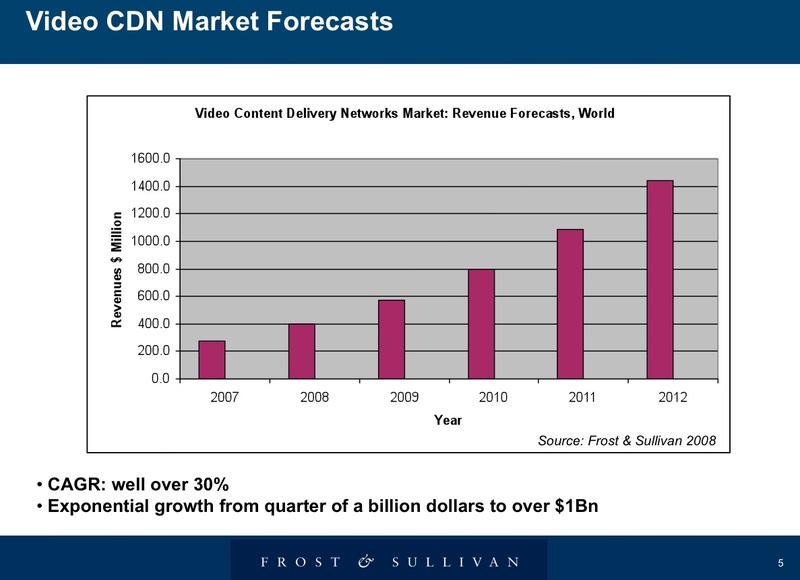
Worldwide Video CDN Revenue $400 Million In 08, Grow To Over $1.4 Billion By 2012

Yesterday, on my Frost & Sullivan webinar (stream archives here) (download audio here) about the video CDN market, we released preliminary data from the upcoming Frost & Sullivan report entitled "World Content Delivery Networks Market". Due out next month, this report will break out the worldwide CDN revenue, specific to video delivery in the North America, Europe and Asia Pacific regions.

The preliminary data shows that the worldwide video CDN revenue will be a little more than $400 million in 2008, increasing at a Compound Annual Growth Rate (CAGR) of more than 30%. As the slide below shows, we expect the worldwide video CDN revenue to grow to more than $1.4 billion by 2012.

Cdnmarket_7

These numbers are very specific to revenue obtained for video delivery services by CDNs and does not include revenue from P2P based networks or any type of content outside of video. While the report, when released, will also break out P2P based revenue and include additional types of content like gaming, these numbers are for video delivery only. To obtain these numbers, we spoke to every major CDN provider in North America, Europe and Asia and obtained revenue numbers or guidance, from nearly every one, on what percentage of their revenue came from just video and from what region.

While there have been a lot of reports put out lately on the CDN market, I had yet to see one that breaks out revenue for just video delivery, which as everyone knows, is one of the fastest growing segments of the overall CDN industry. Delivering video is a completely different animal than delivering other types of content and we think it is important to treat it as such and provide data specific to that market. When released, the report will also detail the market drivers, restraints, market share, competitive analysis, and industry challenges specific to the video delivery industry.

Eight months ago, I wrote a post on my blog that gave out numbers on the size of the video CDN market. These Frost & Sullivan numbers are more accurate and more specific since we spent a lot of time interviewing every CDN, including those outside the U.S. Also, my previous numbers from last year contained revenue from some P2P based services and other content such as gaming, which is not really classified as video and should be put in the application category. These numbers also contain more realistic growth projections based on having spent weeks speaking to every major CDN.

That being said, what factors going forward have the ability to affect and alter these numbers? Clearly, many forces are at play in the market and faster adoption of HD content, mobile video and other consumer facing content services have the ability to grow the market faster. While some may assume that the market will grow larger by the entrance of new CDN players, like carriers or telcos, that won’t change the market size, only the market share.

Putting exact numbers to any industry, let alone a specific segment of the industry like outsourced video delivery, takes collecting a lot of data and speaking with every vendor in the market on a regular basis as well as speaking to hundreds of customers. Once the report is finalized and ready for release, it will provide a lot more granular details on the data and will talk about market factors that could change the market sizing either way. Frost & Sullivan will be tracking the CDN market very closely over the next 12 months and we’ll update these numbers based on new data we collect. I will also be doing additional webinars on the CDN market so I can answer as many questions as possible about the market and the industry’s growth. You can always find the latest data we have on the size of the video CDN market at www.cdnmarket.com

Market sizing data from this post can be used by anyone as long as you credit Frost & Sullivan.