Join Me For A Free Frost & Sullivan Webinar On The CDN Market

On Wednesday August 20th, I will be hosting my first Frost & Sullivan Analyst Briefing on the CDN market. Each month, Frost & Sullivan analysts provide free briefings on a variety of topics in the Information & Communication Technologies (ICT) industry and this month I will be covering the latest trends and data from the CDN market.

This webinar will also highlight data from our new report we will be releasing next month entitled "World Content Delivery Networks Market". The report will provide revenue and demand forecasts for CDN solution providers and peer-to-peer based solutions broken out geographically in different regional markets: Americas, EMEA, and Asia Pacific.

Along with audience Q&A, these points will also be discussed:

  • New CDN players in the market
  • Recent acquisitions and VC funding
  • Size of the market opportunity
  • Impact telcos may have in the industry
  • The role P2P and hybrid networks may play
  • Growth drivers and barriers in the market

You can register for this free webinar on the Frost & Sullivan website and can submit questions to me via e-mail in advance. If there is a topic you want to see me cover, let me know. The webinar starts at 11am EDT and will last about an hour, or as long as you have questions.

I am going to do as many of these free webinars as possible on various topics surrounding the online video space, not just CDN. At Frost & Sullivan, we have many reports coming up on the online video industry including: World Video Server Market, World Video Encoding Market, World Streaming Platforms Market, World Enterprise Content Management Market, World Digital Rights Management Market, World Digital Media Storage Market and World IPTV Server Market amongst others. If you’d like a complete list of all future reports, send me an e-mail.

Sponsored by

Digging Deeper On Key Points From Limelight’s Earnings Call

Yesterday, on Limelight Networks Q2 earnings call, various segments of their business was talked about on a high level that is worth digging deeper into. For starters, one of the biggest questions Wall Street seems to be asking is why did Akamai have a weak Q2 for CDN and Limelight had a strong one? The reason is not pricing pressure, lack of traffic growth or any of the other reasons people want to give. The bottom line is that Limelight simply had a good sales quarter, were aggressive in the market and won some business from Akamai. In quarters past, Akamai has had good quarters while Limelight’s have been bad. That’s the way it works and the winner will be the one who shows consistency with sales. It takes more than one or two quarters to declare a real shift and change in the market landscape.

Based on what both companies reported, Limelight’s CDN traffic does seem to be growing faster than Akamai’s. Notice I didn’t say is larger than, as we don’t know, but simply growing faster. While not discussed on the call, all of the Stage6.com traffic that Limelight lost when Stage6.com closed down, has already been made up by Limelight with new traffic. That’s something to think about considering that Stage6.com was one of the largest traffic sites on the web, doing close to 20 million unique visitors a month when it was shut down. Limelight has replaced all of that lost traffic with new traffic, in only 4 months time, which is a good sign of traffic growth. Of course to be successful, and more importantly profitable, you need more than traffic growth, you need revenue growth. But if you can grow traffic and not have any pricing pressure, which I didn’t see Limelight having in the last quarter, that’s the fastest way to increase revenue.

Another interesting thing not mentioned on the call yesterday is that on the second Tuesday of every month, Microsoft delivers software security updates. Limelight delivers more than half of that traffic for those updates and yesterday, Microsoft released 11 security updates that addressed vulnerabilities in Microsoft Windows, Microsoft Office, and Internet Explorer. That means Limelight’s network was delivering a huge amount of traffic for software updates and the Olympics, all at the same time.

The most interesting thing Limelight said on the call, with very little details, is that they would spend more in the second half of the year to build out their network for business they had won, but traffic they would have to take away from competitors or from in-house. While that seemed to confuse many on Wall Street, it makes a lot of sense if you really follow the CDN market. While Limelight won’t talk about the NFL business that I have confirmed they have won, it’s a great example of a customer who’s business that have won, but so far, have only been committed to be given half the traffic. The other half is to be delivered by Akamai. Without coming out and saying it, Limelight is challenging Akamai head on to take all of that business and show customers it is going to ramp up the capacity of their network to a whole new level by the end of the year.

In addition, this buildout makes Limelight a much stronger acquisition target by the telcos in six months time. What telco wants to acquire a CDN who they then have to put a bunch of money into to have the network ready for the next phase of video growth? By Limelight spending the money now, in six months time they will have built out their network for round two and will be a more valuable acquisition target.

The Current State of the Content Delivery Market

To those who are new to the online video industry, it may seem like the content delivery market has been around for only a few years. But amazingly, 2008 marks the 13th year since some of the first content delivery networks (CDNs)—such as Sandpiper and Real Broadcast Networks—began offering streaming media services on the internet. In that time frame, the video delivery market has gone through enormous changes, both from a technology standpoint and assorted business standpoints, including how these services are priced, packaged, productized, and marketed.

Now that the service is evolving and the process of delivering bits has become somewhat of a commodity, people in the industry are just starting to talk about all of the other pieces in the content ecosystem. Today, most CDNs are still focused only on moving bits across the internet, while many content owners are struggling to figure out all of the other pieces in the workflow process that truly enable them to monetize their content. Delivering bits is not the complex part. Content owners are wrestling with the entire ecosystem workflow of content creation, capture, ingestion, transcoding, management, authentication, syndication, storage, delivery, and reporting, among other possible steps.

That being said, video delivery networks still play a vital role in the industry and will continue to do so down the road. Today, almost no company builds out its own video delivery network, as most CDNs can do it far more economically and efficiently than a content publisher can, especially when capacity and global reach are crucial.

As CDNs evolve, so does the term. Today, there is still no clear definition agreed upon by the industry that determines which companies will be classified as a CDN and which won’t. The term is very vague and continues to have a very broad definition as more types of content outside of video—such as applications—are delivered across CDNs. Everyone seems to have a different answer as to what makes a company a CDN and what kind of infrastructure CDNs are required to have in place in order to use the term.

Even with that confusion, the video delivery market is hot. In the past 6 months alone, the content delivery market specific to video has seen some enormous growth in the number of new vendors in the market, the amount of venture capital raised, and the expectations many people have regarding what the video market will grow into down the road. We’ve seen telcos enter the market and lawsuits over patents, and many hybrid or P2P-only networks have entered the fray. There are more than 50 video delivery networks now in the industry (see www.cdnlist.com), including those that are P2P-based, and the vast majority of them are competing for the same business in a market that is still small in the U.S.

While many reports in the industry have talked about how the size of the CDN market is much more than a billion dollars, none of those reports break out video-only revenue, which is the fastest growing segment of content delivery and takes up the most bits on any network. Based on my calculations of vendors’ revenue, the market size for outsourced video delivery services in the U.S. was $450 million to $500 million last year and has the potential to grow to about $800 million this year (see www.cdnmarket.com).

At the same time, in the past 18 months, more than 16 video delivery vendors, including P2P-based providers, have raised over $300 million in capital. CDNetworks, EdgeCast Networks, Panther Express, GridNetworks, Highwinds Network Group, Velocix, ITIVA, Move Networks, Pando Networks, Conviva (formerly Rinera), BitTorrent, ChinaCache, RawFlow, Oversi Networks and BitGravity combined raised $285.35 million in 2007 and 2008, and that number does not take into account other CDNs that have already raised money but have not yet made it public or those that are out in the market raising another round. When all is said and done, I expect close to another $100 million will be raised in the next 12 months. Combine this much money being raised with a market that’s not as big as some think and one has to worry that, in the next 18 months, the number of video delivery networks in the industry will fall considerably. The market can’t support 50 providers, and not every company will be acquired and make back their investors’ money.

History has a way of repeating itself, and we have gone through this before. In 2000, before the bubble burst, we had nearly 50 CDN providers in the market. Two years later, we had less than 10. Five years later, we’re back to 50, but for how long? At some point, investors are going to want to see some return on their money, and with fewer video delivery networks focusing on doing more than just delivering bits, it’s going to be hard to get acquired unless they can show a lot of revenue, which most don’t have.

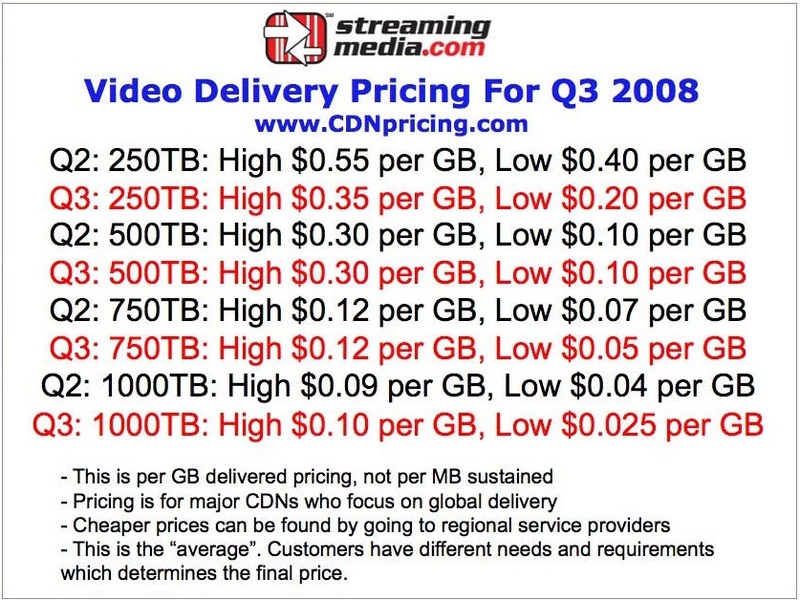
While all this is going on inside the industry, on the outside, customers who are trying to choose the right video delivery network for their needs are more confused than ever. Thirteen years on, there are still no standards for online video and no agreed-upon way to fairly compare one vendor against another for the many different levels of services. In addition, while video delivery pricing continues to drop each year (see www.cdnpricing.com), it’s no longer falling at the rates we have seen in years past. All the while, consumers are watching more online video content more frequently, at higher bitrates, for longer periods of time, and on more devices. More than ever, CDNs are a crucial piece of the puzzle in helping this industry grow to the next level.

When it comes right down to it, the entire CDN market hinges on the ability of all CDNs to be able to use the economics of scale to operate their networks more efficiently. They need to spend less money to deliver more content with fewer resources and less infrastructure so they can reduce pricing to drive more consumption while still trying to earn a profit. Today, most CDNs are still losing money and spending a lot on capital expenditures, all while trying to stand out in a very crowded market.

Continue reading at StreamingMedia.com >>>

CDN Funding Tops $400 Million In Past 18 Months: BitGravity The Latest

In the past 18 months, CDN and P2P based delivery vendors have raised over $300 million to build out and deploy content delivery services. So it should be no surprise to hear that BitGravity announced last week that it had raised $2.5 million from Allen and Company and Blake Krikorian, the co-founder and CEO of Sling Media

Adding up all the investments that CDNetworks, EdgeCast, Panther Express, Grid Networks, Highwinds,
Velocix, Itiva, Move Networks, Pando Networks, Conviva, BitTorrent,
ChinaCache, Rawflow, Oversi and BitGravity have gotten, and it totals $285.35 million. In addition to these sixteen providers, Kontki, SimpleCDN, Vusion and EdgeStream have all raised undisclosed amounts as well which puts the total amount of money raised into the CDN space well over $325 million. And if we think of AT&T’s CDN offering as a startup, which they basically are, with their $75 million investment into their network this year, that puts the total amount of money raised to over $400 million in the past 18 months.

In addition, while BitGravity is the latest to raise money, they won’t be the last. There are at least three to four new CDNs in the U.S. and Asia who are gearing up to enter the CDN market and have already raised, or are in the process of raising money. I am amazed that companies continue to be able to raise money for a new CDN business when there are already over 50 CDN providers and the market is not big enough, and won’t grow fast enough to support them all.

The CDN market is going to be in for a world of hurt in 18-24 months, and most of these CDNs are not going to get acquired or bought out at all, let alone at the kind of revenue multiple investors are dreaming of.

How To Watch The Olympics With Silverlight OR Windows Media Player

Since a lot of viewers are querying Google on how to watch the Olympics without having to use the Silverlight player and instead use the Windows Media player, here are the instructions.

Go to www.NBCOlympics.com and click on the video tab. Then click any video to watch and you’ll get a popup window with video in it. If you already have the Silverlight player installed it will automatically use that unless you click the "standard player" link. Doing that will put you into a single stream that uses the Windows Media player. If you do not have Silverlight installed, you will get the option to install it. If you don’t, you will just get a Windows Media based stream

Still having problems? E-mail me and I’ll try and help.

Google Searches Provide Insight Into Silverlight And The Olympics

Last week I had a blog post talking about Microsoft’s Silverlight player and the Olympics and thanks to Google, many of the phrases people are typing into Google about the Olympics are bringing them to my blog. The interesting thing about this is that Typepad allows me to see what phrases people are searching for pertaining to Silverlight and the Olympics. I’m sure someone who knows Google better than I do knows of a place on Google’s site where you can see the most common searches for this subject, but looking at Typepad’s reporting gives me some interesting results.

While a lot of the search queries are very generic like "watch olympics" and "watch olympics with silverlight" many of them are very specific to problems people are having. I’m getting a lot of traffic from phrases like "silverlight admin", "silverlight buffering", "should I install silverlight", "silverlight olympic issues", "silverlight not working", "silverlight buffering problems", "olympics video player slow" and other assorted phrases. I’m also getting a lot of traffic from search results pertaining to people who want to use Windows Media to watch the Olympics instead of Silverlight.

By itself, these search phrases are not an indication that the Silverlight player or Limelight Networks are having any problems delivering the video. But it does serve as a reminder to us of just how many viewers still have problems with video players today. Some viewers are clearly having their own connectivity issues, don’t have admin rights for new player installs, don’t have the latest version of the player or don’t want to install a new version. And while some anti-Microsoft people are going to want to comment that this would not be the case if Flash was being used, think again. While I will admit that there would be fewer issues due to the fact that the Silverlight player is newer than Flash, using Flash would not solve the problem. The number two post ever on my blog, thanks to Google referrals is to a post entitled "MSNBC Debate Webcast Constantly Buffering, Poor Audio". I still get tons of traffic to this post as so many users still have problems with Flash video on MSNBC. This is primarily due to MSNBC problems, but it still shows that no matter what player(s) are used, especially for live events, viewers are always going to have a wide assortment of problems that reside on their end.

If you are a viewer who came across this post looking for help to watch the Olympics, send me an e-mail with the problem you are having and I’ll try and point you in the right direction.

No Value To Akamai In Acquiring Limelight Networks

In my eyes, there has been too much talk in the past few days from some analysts saying that Akamai should purchase Limelight. What I don’t see any of them explaining is what value that would have to Akamai other than to say it will remove a competitor from the market. So far, that’s all I see them saying. But what about the negative impact that acquiring Limelight could have on Akamai’s business? You don’t hear any of them talking about that or even running the numbers to see just how much Akamai would have to spend.

If Akamai acquired Limelight, they would have to spend a great deal of time and internal resources to see the acquisition through completion. Lots of technical resources would be expended by Akamai to transition customers over to the Akamai network and deal with all of the integration hassle. Akamai just spent the past two years doing all of the integration work from their acquisition of Netli and Nine Systems. The last thing they need right now is to take on more integration work that would be a lot more complex than the last two were. Plus, is now the right time for Akamai to be focusing on anything other than their core business? With the lower than expected guidance Akamai gave last week in their Q2 earning call, Akamai needs to continue to focus on their core business and growth. Acquiring a $100+ million dollar business is not the way to do that and I think Akamai is smart enough to know that.

In addition, Limelight would not be cheap. Even with the shadow that Limelight is under due to Akamai’s patent suit, Limelight is still close to doing $125 million this year in revenue. Akamai’s would still have to pay over $400 million for Limelight, even if Limelight eventually have to pay some sort of penalty to Akamai. Limelight is not is a desperate situation. They have cash, they have customers and they are not going away anytime soon. And if for some reason things got so bad at Limelight that they had to sell, you know they would shop the company to multiple players others than Akamai and get as much as they could for it. There is a good bet that many would pay more for Limelight, think telcos, than Akamai would be willing to.

But lets look past that and say Akamai acquired Limelight. What do they get? They don’t need Limelight’s network, don’t need their hardware and infrastructure, Limelight has no granted patents that I am aware of and has no applications or ecosystem components they own. Yes, Limelight has customers and revenue, which is all Akamai would want. But, what percentage of Limelight customers would Akamai keep in an acquisition? My bet would be less than 40%. If Limelight does $125 million this year, Akamai would add roughly $50 million to their top line revenue. And with 20 of Limelight’s customers making up 50% of their revenue, clearly Akamai could very easily get much less than 40% of Limelight’s revenue. And keep in mind that Microsoft likes to spread their business around to multiple CDNs. So the idea that all of a sudden Microsoft or other large content owners would all of a sudden consolidate all of their business with Akamai, or any single provider, just isn’t happening.

So does it make sense for Akamai to spend at least $400 million to acquire Limelight, have to use a lot of internal resources, increase their revenue by a small percentage and do all of that just to remove a competitor from the market? I don’t think so. I think too many people are looking to when Akamai sued Speedera and then acquired them and think the same will happen to Limelight. Great, but that’s not a fair comparison. The quarter before Speedera was acquired, Speedera did just over $8 million in revenue. Limelight is averaging 4x that per quarter. Speedera was acquired for $130 million in Akamai stock. It would take at least 3x that in order for Akamai to acquire Limelight.

That’s not to say that Akamai can’t acquire Limelight, anything can happen. But I don’t see any reason why they would or what they would get from it. Someone thinks otherwise, other than you own stock and want to see it happen, happy to hear it in the comments section.