
Niche Video Networks: Can Content Owners Make Money?

I get a lot of calls and e-mails from content owners of all sizes. Aside from the major broadcasters, many of those who contact me are smaller content owners producing their own online content and are trying to figure out their distribution, syndication and advertising strategy. In the past 12-18 months, niche video networks or micro video networks as some call them, such as For Your Imagination and Next New Networks have ramped up their offerings for small content producers trying to gain their business. At the same time, video platforms like Babelgum and Brightcove are also competing for these same content owners and the differences between a network and a platform continue to confuse people.

These types of aggregators and networks offer content creators a promising new vehicle for syndicating and monetizing content that would be hard to do on their own, but many of those content owners keep asking what exactly the niche video networks offer and how the business relationship works? Much more info is needed on how these services actually operate and whether they might be good partners for content owners looking for an effective channel for distribution and monetization. As an industry, we talk about the value the networks provide, but from a very high-level with few details. As a result, content owners don’t know where to start and I get the same frequently asked questions all the time.

To try and shed some light on this for content owners, I asked Revision3, Next New Networks and For Your Imagination amongst other, on how they explain their business model to content owners and how they set customers expectation properly on licensing, syndication and ad revenue.

The first question I am always asked is are these networks looking to license content, or are they primarily interested in acquiring and owning content? From those I spoke with, the consensus was that most networks look for a non-exclusive licensing type agreement that is based upon an advertising rev share, which is what most of the video sharing networks offer today. Some destination type sites may ask for an exclusive license for a fee upfront with no rev share, but those are less common. Another model might be the opportunity for a content owner to produce exclusive new content for a destination type site which works as a work for hire type of relationship.

Of course, content owners also want to know how is ad revenue generated and shared with content owners? Generally, rev share is some kind of a split of net revenues, maybe as much as 50/50 for on network and some three way split if it is on a publisher network. Net revenue is calculated by taking gross revenue minus any network costs for your content and the ad campaign, such as operations, management and hosting. Those costs usually amount to about 25% of the gross, with the remaining balance split with the content creator. While it sounds easy enough, the problem is that there is no "average" split of net revenues. The only true way for a content owner to know how much their split would be is to get an actual quote from the network.

Another question often asked is what demographics are networks interested in reaching? Only 18 – 30 yr. old males, or a wider audience? Each network has a different focus and target vertical, but for the most part, the wider and more generic the network the more broad the demographic reach is. The niche networks can get more specific and as a result should be able to offer better rev share models, but it may end up content owners get less revenue because the traffic is smaller. Targeted should mean better CPMs, but that’s not always the case and it’s nearly impossible to get the networks to tell you their CPM average across a certain type of content or niche vertical.

With all the talk in the industry of the costs to deliver video online, many content owners also ask if the networks pay for the bandwidth of delivering content from the website, or does the content owner foot the bill? If you are using a platform, like Brigthcove, the content owner foots the bill. If you are using a network, it can go both ways. For Your Imagination says that when they embed a video with blip.tv, Viddler or Revver player for example, those companies cover the delivery costs of the video in return for the right to sell ads on the videos and to share the revenue with For Your Imagination. For Your Imagination says this is super important because even though a show may not make a lot of money, at least they are no video delivery fees which for some shows can be expensive, easily over $1000 a month.

As for the question of what’s the duration of and standard provisions offered in a typical contract? All of those I spoke with said their is no "typical" contract as so many variables are taken into account. That being the case, I have yet to see any niche video network publish a list of all the factors that are taken into account that determine their contract terms with a content owner. I understand if you don’t want to publish your rates, but wouldn’t it be nice if content owners had some idea of what factors affect the revenue share numbers?

A lot more work is needed by the nice video networks and video platform providers to make their pricing and business terms easier to understand for content owners. If it was made easier to understand, content owners wouldn’t be so confused and the market would grow faster. We’d see more adoption and more usage of online video and we’d have a better chance of content owners not having to struggle to figure out what the pricing is, how it works and what their cost would be. And it’s just not the networks that have this problem, the platform providers as worse. Last week I was trying to help a content owner review pricing from both Brightcove and thePlatform and trying to decipher what the terms are that they use is confusing even for me. On one hand, many of these video platform providers say you pay one price to use the platform, but then charge you for "software platform fees", bandwidth, the number of media clips you have, storage, use of APIs and the number of "user accounts" you have. Come on guys, this needs to get easier.
Sponsored by

Why Aren’t Conferences Including Online Video Topics?

I don’t get to as many conferences as I use to, but I still get to at least half a dozen or so outside of my own. The more conferences I go to and the more agendas I look at, I can’t figure out why so many of these conferences are not including online video topics in their programming?

For example, the INTERACT 08 show taking place in DC later in the year says it will gather together the top creative, strategic, and tactical
marketing minds to speak about proven methods for Interactive Media. They have topics on social media design, evolution of advertising models, bunch of Web 2.0 subjects and some topics that sound pretty interesting that meld the topics of design, creativity and advertising together. The problem is, aside from one session entitled "Creating Rich Internet Applications" which probably will contain a lot about video, none of the more than 25 sessions on the agenda speak to video at all. In fact the word video is not even used in any of the session titles or session descriptions across the agenda, on both days. Now maybe they just don’t want to include video, but personally, it sounds like a pretty good conference to me, and some interesting topics. But it will be very hard to discuss them and showcase "interactive media" without a strong video component.

And what about the Web 2.0 Expo that starts today? They have over 112 sessions across three days and other than two sessions, one by Adobe on RIAs and one about the video ecosystem, there are no other sessions focusing on any aspect of online video. And at this year’s NAB show, while it was all about video, almost none of the sessions were about online video. Topics about broadcast video, mobile video, video editing and IPTV ruled the agenda with a few topics around TV content online.

Am I the only one seeing this trend? Are you visiting non-video/entertainment specific shows and seeing any of them include online video topics in their agenda?

Last Minute Speaking Spots Open At Streaming Media West Show

I just had three last minute cancellations for the below sessions at next week’s Streaming Media West show. If you are interested in filling any of them, contact me ASAP. Customers and end users get first priority, but all are welcome to submit for the spots. If interested, you must send me the speakers name, title, company, bio, e-mail address and postal mailing address. Only complete requests will be responded to.

Tuesday, September 23, 2008 – 11:30 a.m. – 12:30 p.m.
Online Video Publishing and Marketing Strategies
In the world of video publishing, how do you get started? How do you create compelling content? With so many options for live and on-demand video, how do choose your distribution platform? How do you find your niche? Build your audience? Establish your brand? How do you create a sustainable model to monetize your content and generate income? This is an opportunity to hear some of the most well known and respected online video publishers discuss online video publishing and marketing strategies.

Tuesday, September 23, 2008 – 11:30 a.m. – 12:30 p.m.
Best Practices in Enterprise Streaming for Communications and Learning
Use of online video in the enterprise has evolved well beyond the special-occasion, rudimentary talking-head videos that characterized early adoption. Whether webcasting executive briefings across the globe or capturing and archiving rich media presentations for training, marketing, sales, and compliance, a growing number of organizations are capitalizing on the capabilities of Web 2.0 technologies. This session will show examples from Fortune 500 organizations of best practices in integrated online video for communications and learning.

Wednesday, September 24, 2008 – 4:15 p.m. –5:15 p.m.
Planning & Executing Successful Webcasts
No longer just a conduit for corporate communications, webcasting offers exciting ways to engage targeted audiences. Whether it’s for internal purposes like training, sales, and marketing or consumer-facing entertainment events, effectively reaching your audience requires understanding the strengths and weaknesses of existing technologies, following guidelines for assembling event resources, and selecting the best channel for message delivery. Hear several case studies from webcast events and gain valuable insights into webcasting best practices.

Market Overview For Video Transcoding Services

When it comes to delivering online video, content owners continue to need more services than just pushing bits across a network. The real struggle moving forward is trying to solve the entire ecosystem of video creation, ingestion, transcoding, management, storage, distribution and tracking. Not to mention all of the other sub-categories of management like authentication, meta data, business rules, etc.

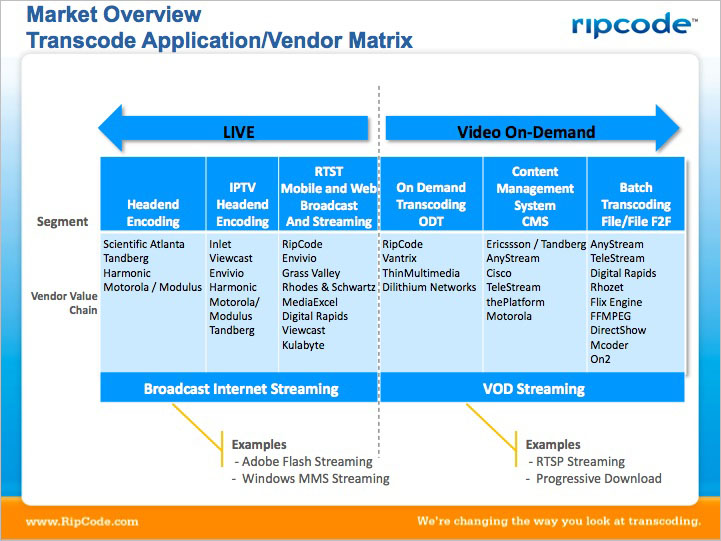
The question I often get asked is who’s in the transcoding market and what segments of the market are they going after? In a recent conversation I had with Ripcode, they shared with me one of their slides that breaks out the different vendors in the market and the segments or verticals each vendor is going after. While I am sure there are a few more vendors that could be listed, especially for mobile transcoding, the slide does a good job of capturing who’s in the market today and what they are focusing on.

Transcoding_4

While transcoding is a small market today, it’s only going to grow larger as more content owners place more videos online, in more formats, for more devices. Over time, transcoding is going to become a mainstay functionality of the CDNs and we are already beginning to see more content delivery networks think about the ecosystem for video, including transcoding. In addition, some content owners have the ability and resources to do their own transcoding and for some, it makes sense to keep it in-house. The transcoding solutions on the market today are a lot cheaper and more efficient than they were three or four years ago and provide the ability to turn around videos very quickly for content owners who have the internal manpower.

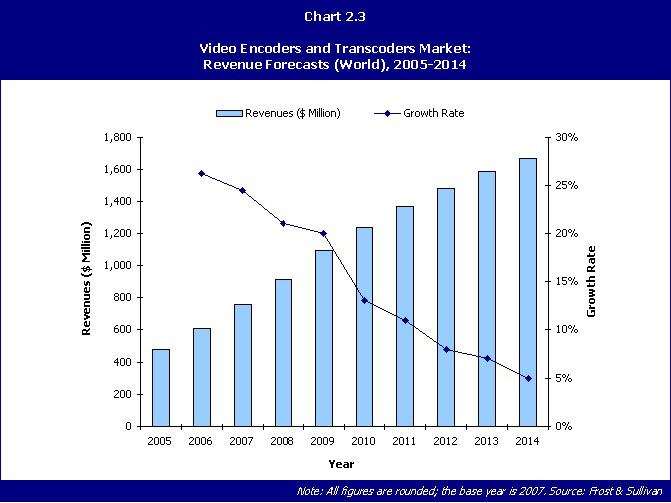
Last year, Frost & Sullivan released a report entitled "Video Encoders and Transcoder Market" which contains a slide that shows the revenue forecasts and growth rate for 2005-2014.

Transcodingmarket_2

The Frost & Sullivan report details that over the next few years, while the size of the transcoding and video encoder market continues to grow, it will so do at a slower rate, due to competition driving prices down and product saturation down the
road. They still have the market growing but at decreasing rates as
digitization becomes well established globally over the forecast period.

While transcoding is not a service you hear many people talking about in the industry, it is a topic that you hear raised quite often when speaking to a large number of customers. Over time, transcoding should become a technology that is built into the network layer of content delivery and hopefully will be seen less as a stand-alone product offering. The key thing to remember is that if content owners can’t get their video into the right format, for the right device, they content can’t be delivered.


Online Video Networking Events and Parties In San Jose, Week Of Sept 22nd

The week of the Sept. 22nd, during the Streaming Media West show in San Jose, numerous networking events and parties are taking place for those interested in meeting with others from the online video industry.

Monday Sept. 22nd
Informal Speakers Meetup
Location: Acadia bar in the Marriott Hotel
Time: 7:00pm-9:00pm
No RSVP needed, all welcome

Tuesday Sept. 23rd
Streaming Media West Opening Reception
Location: Convention Center Exhibit Hall
Time: 5:00pm-7:00pm
No RSVP needed, just register for a free exhibit pass to get in

Online Video Producers Meetup (organized by Tilzy.tv and TubeMogul)
Location: Convention center lobby area outside the Streaming Media West exhibit hall
Time: 7:00pm-9:00pm
RSVP at: http://www.tilzy.tv/producers-meetup

Abobe Cocktail Reception
Location: Adobe Headquarters, 345 Park Avenue, San Jose
Time: 7:15pm-9:00pm
RSVP Required, Space is limited: http://www.eventsadobe.com/smw2008/user_info.php

Wednesday Sept. 24th
Streaming Media Magazine Readers Choice Awards
Location: Grande Ballroom, Sainte Claire Hotel (next to the convention center)
Time: 7:30pm-9:30pm
Awards presentation starts at 8pm

In addition to these events, other vendors are having their own private networking functions. If there is one you really want to go to, let me know and I’ll see if I can get you in.

Writers Being Led Astray About CDNs, Wall Street Journal The Latest

Yesterday, the Wall Street Journal published a blog post entitled "Moving Bits through Private Pipes" that talks about content delivery networks and describes how video is delivered. The problem is that like many writers covering the topic, they only get their info from vendors and assume what the vendors are telling them is true. Or they use phrases and words in the post without really knowing how they tie into the technology and don’t challenge any of the quotes they get from analysts.

The author says that, "Multimedia communication — particularly video — has caused a strain on public networks, degrading the quality, so privatized networks have become more attractive over the last few years." Where’s proof that the public networks are under any "strain"? And what CDNs have "privatized" networks? CDNs do not have "private" networks. They have private cross-connects and things like private peering, but the networks themselves are not "private". They are all delivering content over the Internet, which is public. Yes, some CDNs own the pipes, but the content to the end user is not being delivered from a "private" network.

Berge Avayzian, an analyst with the Yankee Group is quoted in the article as saying, "Video is a huge game changer but its big and bulky, so sending video files over traditional Internet pipes is flawed." What are "traditional internet pipes"? Are there any internet pipes that are un-traditional? And what does Berge classify as being the flaw? The CDN space for video this year alone is north of $400 million, so the "flaw" does not seem to be stopping the market from growing or vendors from growing revenue.

The author of the blog goes on to quote Tata over the recently announced relationship with BitGravity but the statements don’t make any sense. Tata is quoted as saying that "BitGravity’s network is designed specifically to handle video," as if they are the only one. Limelight’s network was specifically built to handle video from the very first day they launched, years before BitGravity. Tata is also quoted as saying, "The internet as we know is changing, it’s much more of multi-media, communications medium now. Outdated hardware and infrastructure can’t handle that." Who has outdated hardware and infrastructure?

BitGravity and others need to stop coming to the market and saying their content delivery networks are "next-generation" and as a result, Akamai, Limelight and everyone else must be using old, outdated hardware and have a legacy network. What do you think guys like Akamai and Limelight are spending all these CAPEX dollars on? They are not running outdated hardware and their size of their CDN revenue shows that their networks are not outdated. And what about someone like Level 3 who has built out their network in the past 18 months? Does that mean that are using all outdated gear also?

The idea that just because a CDN has been around for more than a few years they are somehow falling behind in being able to deliver content is not accurate. I’d say the opposite. They have more real-world experience building out their network to deliver video and have an advantage over any new CDN who simply does not have the hands-on experience, the volume of traffic or the number of customers that a well-established CDN has.

BitGravity, it’s not in your best interest, or the industry’s for that matter, to keep trying to portray every other CDN as outdated. If you want the industry to seriously consider your network to be some sort of "next-generation", then put on your website a white paper explaining how it is technically different, with technical details. Because without details, all you are giving us is marketing speak. Looking at the technical page on BitGravity’s website gives us no description whatsoever of the technology.

For Bobby White who wrote the article on the WSJ, I feel for him. If CDN is not a topic he tracks and covers on a regular basis, it is very hard for him or any other author to get the straight details, minus marketing speak from many of those in the CDN market. I don’t fault someone like Bobby for quality of the blog post he wrote, I fault vendors and analysts in the market who don’t take the time to truly explain the business, the technology or the terms in our industry to a writer who is trying to cover our market.

Breaking News: Microsoft Announces Future Support For H.264 In Silverlight

H264logo
This morning Microsoft made the move that many content creators had been hoping they would do for some time. Microsoft announced that H.264 and AAC support will be available in a future version of Silverlight. While H.264 support won’t come till sometime next year, later in the week at IBC, Microsoft will demonstrate a technical preview of H.264 and Silverlight in action.

In my conversation with Microsoft yesterday and in the Q&A that Microsoft released this morning with Scott Guthrie, corporate VP of the Developer Division at Microsoft, additional details have come to light. When asked if this means that Silverlight is moving away from Windows Media Scott says, "Not at all. This is about offering our customers more choice." That hits the nail on the head. Give customers what they want. Customers have been asking Microsoft to adopt H.264 and give them more options.

The Q&A also covers some details regarding Microsoft’s recent investment in Move Networks and announces a bunch of new major broadcasters in Europe who will be using Silverlight. Microsoft also says that Silverlight 2 is scheduled for final release this fall and takes a jab at Adobe over viewing data for the Olympics content saying, "On the Silverlight-enhanced NBC Olympics site, the average viewing time was over 27 minutes, as opposed to an average of just three minutes on some Flash-powered sites broadcasting Olympics coverage elsewhere. We think this indicates Silverlight provides a more compelling, engaging and rich media experience for viewers." I don’t know where the three-minute data comes from, but clearly Microsoft is saying that better quality equals a longer viewing experience.

One the H.264 front, while the announcement will be a surprise to many, it should be noted that Microsoft has been an active participant in the standardization of H.264/MPEG AVC for many years. Microsoft’s Gary Sullivan was the chairman of the Joint Video Team (JVT), which developed the H.264 standard, and he recently accepted an Emmy Award on behalf of the JVT.

For many of us in the industry, we knew it was only a matter of time before Microsoft adopted H.264, the sooner, the better. Now, it’s going to get really interesting. If the industry can rally around making H.264 a standard, even if it is just for video on-demand to start, this would benefit all content owners in the long run. More details about H.264 and Silverlight will be talked about in two weeks at the Streaming Media West show and Microsoft will be in attendance on the exhibit floor. Sign up now and get a free pass to get in hear more about this from Microsoft.