NBC and Microsoft Kick Off NFL Season Tonight, Akamai Doing The Delivery

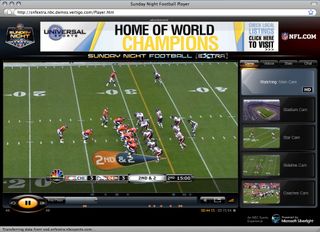
Nfl Tonight at 8pm ET, NBC will once again kick off the start of the NFL season by streaming 17 games this year on NBCSports.com and the NFL.com website. The service which will be powered by Silverlight and Microsoft's Smooth Streaming technology will offer a total of five different camera feeds, 720p HD quality, picture-in-picture functionality and the ability to pause the video and watch it in slow motion.

The player includes tabs for the ability to chat and ask questions to announcers, get details on stats, see video on demand clips and will enable users to scroll back to highlights in the game that are noted by a small symbol above the scroll bar. The player gives uses the ability to see real-time details on the quality of the video being delivered by showing the current bitrate being streamed as well as the maximum bitrate the video is encoded for and has the ability to go full-screen. Akamai is the exclusive delivery provider for these games and I expect we'll see NBC put out some details on viewer numbers once the season gets under way. NBC has a pretty good track history of giving out details on consumption from their online video offerings so I expect we'll hear more about it.

While NBC has a dedicated sales team that is selling ads for the games along with other online properties and has said they will do well with their ad sales, they aren't yet willing to project what this might bring in revenue wise other than to say "seven figures". Whether or not that pays for the service itself is not known, but with 17 games over the course of the year, one would have to imagine NBC is making money from streaming. But since Microsoft and NBC are both sharing in the revenue and not knowing if they have to give the NFL or anyone else a cut of the ad sales, it will be interesting to see what details they are willing to give out during the season.

Sponsored by

Who Wants To Co-Host A Networking Event With Us At Streaming Media West?

Images With the Streaming Media West show only two months away, we're looking at hosting a big networking event on the first night of the show, Tuesday November 17th. We have a couple of great spaces in the San Jose McEnery Convention Center and want to use it to foster some good industry networking. We're currently looking for any other blogs, associations or news sites who want to co-host the event with us, help promote it, get branding on-site and simply work with us to bring the industry together. The event will be free for everyone and we're not looking to make money from this but rather provide a good networking forum.

If you're interested in helping out, please contact me and we can share ideas. We have the space already, would be a shame not to put it to good use. Also, if your company wants some great exposure and branding and is willing to cover the cost of some drinks, we'd be interested in that as well.

Streaming Media West: Speaking Spots Still Open, But Not For Long

Now that the holiday is over, I am hard at work to secure the remaining open speaking spots at the Streaming Media West show in San Jose in November. We have 113 speaking spots in total and about 70% are already spoken for.  We have confirmed speakers from Xbox, MTV Networks, Sling Media, Roku, PBS, Adobe, Motorola, Turner Broadcasting, Revision3, Boxee, Move Networks, All Things Digital, NBC, NHL, GigaOm, Microsoft, Lockheed Martin, TiVo, ZillionTV, EPIX, Amazon Web Services, AP, MobiTV, CNN, Comcast, Verizon, Conde Nast Digital and many others.

While I still have many submissions to sort through, there are a bunch of open spots where I am looking for very specific speakers. Here is what's open and please make sure to read the details about each opportunity before you email me.

Tuesday Nov. 17th, 2009

Panel Session: The Evolution of Over-the-Top Video
Looking for content companies offering over-the-top video, MSO's or analysts and bloggers who write about and cover this subject in depth.

Panel Session: Monetization And Video Advertising Formats
Looking for a moderator for this session who has a lot of expertise with the different ad formats on the market and someone who is willing to take this session and re-focus it to talk about a facet of the online video advertising business.

Wednesday Nov. 18th, 2009

Panel Session: Monetizing Long-Form Video
Looking for a moderator for this session who can talk about how sites like Hulu are starting to get some traction with long-form video in addition to some of the content owners speaking on this session who will showcase a few examples of their own.

Thursday Nov. 19th, 2009

Panel Session: Live Broadcasts And HD Video: Can Web Video Ever Scale To TV-Sized Audiences?
This was a session I moderated myself at East and may do again for West, but am open to moderator suggestions as well as speaker suggestions. The focus on this panel will be about whether or not live events can make money, what the business model is, how it relates to TV distribution and whether or not the Internet can truly handle HD quality live events.

Panel Session: How Old Media Is Embracing Online Video and New Media
Looking for a moderator for this session, which contains a nice mix of old and new school media companies on the panel.

If you are interested in any of these speaking opportunities, please contact me ASAP and don't just send me an email saying, I want the spot. Please send me some details on your background, your bio, what prior speaking/moderating experience you have and how you are a fit for that particular topic.

Level 3 Comments On The Future Of HTTP Based Streaming

Over on the StreamingMedia.com discussion lists, a big debate has been raging over whether or not HTTP based streaming and services like Smooth Streaming are cheaper for content delivery networks to deploy. Earlier in the week I wrote a post saying that today, it's not cheaper to deploy and for content owners, doesn't cost them any less than other forms of delivery. With both Microsoft and Apple making a strong push for HTTP based streaming and Adobe hinting since the beginning of the year that they will provide support for it before too long, there's no question that HTTP based streaming will play a big
role in the future of video delivery.

While I spoke to a couple of CDNs about their HTTP deployments for both Apple and Microsoft's platforms, Level 3 was willing to give out some additional details for the blog and I did a quick Q&A with Mark Taylor, the Head of Media Product and Strategy at Level 3. Here are his thoughts on HTTP based streaming and some of the positive signs Level 3 is seeing with their deployments.

Question: Is HTTP based streaming cheaper for Level 3 to deploy and manage today when compared to FMS and WMS services?

Yes. There are three areas where it is more cost effective for a CDN.

Firstly, we have no software integration on any of our edge servers with the new HTTP streaming solutions. For significant new versions of proprietary streaming protocols, that do not use HTTP, this integration is a significant amount of work for our development teams. We effectively have to fold the new technology into our own ecosystem. There are a lot of things we have to build to turn the streaming vendor's code, a framework really, into a functional service. And even when we have the code built we have to go through rigorous regression testing before we can roll it out onto the thousands of servers throughout our network – we clearly have to be completely satisfied that no existing customers will be impacted negatively. Contrast that with the new HTTP-based streaming technologies where we need do almost nothing; maybe a few tweaks to our existing caching code in order to improve efficiency. And of course nearly every time there is a new feature or a code upgrade we need to go through the same cycle again.

Secondly, it is simpler and more efficient for our operational teams to manage. There is less complexity and we don't need to build any new management tools. Managing one technology is clearly easier than managing many technologies that all essentially do the same thing.

Thirdly, CDNs do not pay any traffic/bandwidth/volume related fees to the HTTP streaming software vendors.

Continue reading »

MLB’s $0.99 Per Game Live Streaming Service Launches On The iPhone

Mlb Apple has just approved the latest update to MLB's iPhone app which now enables any user to pay $0.99 to view any out of market game live on their iPhone. The update to the MLB At Bat app is now live in the iTunes store (version 1.4.0) and available for download. While some might wonder if this new pay-per-view service will also be rolled out to the PC, MLB said the new offering is only slated for mobile devices. In addition to the new pay-per-view functionality, the updated app also includes the ability to deliver customizable push notifications for when games start and end.

The live video streaming is being delivered by Akamai and MLB says to date, they average about 25,000 live streams a day, total, not simultaneous. While that may seem like a low number, keep in mind that the ability to see up to fifteen live games a day was originally only being offered to iPhone users who had a MLB.TV subscription. This new pay-per-view service now opens up the live streaming of all non-blackout games to everyone. While live video streaming is cool, it was no surprise to hear MLB say that the live audio streaming, delivered by Limelight, is one of the most popular features in the app, since the live audio streams are not subject to any blackout restrictions.

In addition to these latest updates to the MLB At Bat 2009 app, MLB said that come the postseason, MLB will introduce Quad View within the app, allowing users to view up to four different live camera angles on one screen with nat sound.

HTTP Streaming Is Not Cheaper To Deliver, Industry Setting Wrong Expectations

Over the past few months, there's been a lot of talk in the industry about HTTP based streaming and how new technologies like Microsoft's Smooth Streaming are going to change the future of video delivery. While most industry insiders want to talk about how technologies like Smooth Streaming enable content delivery networks to scale and delivery video cheaper than using proprietary streaming protocols and servers, to date, no CDN is charging any less for HTTP based streaming.

The big selling point I keep hearing industry people talk about is that since CDNs already have a big footprint of HTTP based servers, they can save money on not having to deploy and manage streaming specific services like FMS and WMS. While this makes sense on paper, the problem I see with the adoption of HTTP based streaming is that none of the CDNs who currently offer it charge any less for HTTP based streaming. While HTTP streaming might be cheaper for them to deploy over time than say RTMP based streaming, if they aren't passing that savings onto the customer, where's the incentive for the content owner to adopt it? Taking away the pricing argument, there are still some great reasons for a content owner to adopt HTTP based streaming, mainly having to do with higher quality, but it seems they don't know what those values are and no one seems to be talking about them.

The other problem with this topic is that industry people automatically assume HTTP streaming is cheaper for CDNs to deploy and manage, yet to date, we have no proof of that. In order to support technologies like Smooth Streaming, CDNs have had to upgrade their networks and get hands on with the technology. They have to deploy it on their network, change the way it ties into their reporting system, since this is now the delivery of chunked files, and become familiar with the service and be prepared to support it. All of that costs the CDNs time and money and until there is a big enough demand for HTTP based streaming, it's not cheaper for any CDN to deliver. Nothing is ever cheaper for a CDN unless it takes into account the economics of scale, something not currently taking place with HTTP based streaming.

Down the road, the opportunity exists for CDNs to better control their internal costs if they can use the same box to delivery any type of content, based on the standard HTTP protocol. But right now, that's not a reality. While we hear a lot of people talking about the incentive for CDNs to move to HTTP based streaming delivery, what's the incentive for the content owner? We see the value for the CDN and one of the corresponding values for the content owner could be that if it costs less for the CDN deliver, they may pass some of that savings onto the customer. But today, that's not happening. And with HTTP based streaming and multi-bitrate encoding, a content owners delivery and storage costs may actually go up, not down. Not to mention, what's the cost to a content owner who has to re-encode their content to support HTTP based streaming?

Since nearly all of the CDNs in the industry already charge one price no matter what format the media is in or what protocol is being used to deliver it, chances are, CDNs won't start discounting HTTP based streaming anytime soon. It's possible that a CDN may start offering HTTP based streaming at a lower cost to make a name for themselves or use it as a marketing pitch, but considering that all CDNs are still trying to become profitable, I don't see that being a tactic of their's anytime soon.

The value in HTTP based streaming and technologies like Smooth Streaming needs to be about something other than cost. I think the industry is setting some really poor expectations with content owners when they have heard that HTTP based streaming is much cheaper to deploy, but then don't get a cheaper price from their CDN when they ask for a quote. Customers I have spoken to are then really confused as to what the value is when it comes to HTTP based streaming services since to date, the industry has only been harping on the lower price argument.

Lower cost is not what the industry should be selling right now, since that's not taking place in the market. Yes, there is an opportunity for content owners to potentially get a lower price in the future if HTTP based streaming takes off and CDNs find a way to pass that savings onto the customer. But until that happens, if it happens, the industry and vendors need to focus on educating content owners on what the value of HTTP based streaming services are today. Not something that may or may not happen down the road.

Added: I forgot to mention that I spoke to both Level 3 and Limelight Networks who said that today, HTTP based streaming is not cheaper for them to deliver.

TV Everywhere Offerings Will Struggle To Be Successful

While there has been a lot of talk about the TV Everywhere trials being rolled out by cable companies (Comcast, Time Warner Cable, Verizon), the sad reality is that none of them have figured out how they are going to pay for the service. While many want to proclaim TV Everywhere offerings as being the future of the cable industry, it's not. No cable company is going to simply give this away and lose tens if not hundreds of millions each year, just so consumers can get cable TV programs on their computer.

No cable company can afford to offer a TV Everywhere product if they aren't recouping their costs to operate it. While Comcast and others have talked about using online video advertising as a way to pay for it, lets be real. Video advertising alone will not pay for the costs associated with a TV Everywhere offering. In the end, cable companies will either raise our cable bill each month to pay for the so called "free" offering, or they will charge an additional fee per month on top of our cable bill. While there is nothing wrong with them offering a new service at an additional price, the majority of consumers won't pay for it.

If there is one thing that consumers have clearly told content owners is that they are not willing to pay for the same piece of content multiple times. I already pay for cable, now I have to pay more each month simply to get that same content to a different device? Consumers won't stand for that. Sure, the cable companies would get some users to pay more each month for the service, but not in the numbers they would need to cover their costs. Just think how much it costs to deliver a 500Kbps video on the internet today and then multiply that cost times six for a TV Everywhere offering that would probably deliver video at around 3Mbps.

In addition, one of the hidden secrets of these TV Everywhere trials is that the more cable executives I speak to, the more of them talk about how not all programming from a station will be available online, even once the offering is out of beta. When we think of TV Everywhere, most of us probably think of being able to turn on a channel on our computer and see the exact same programming we see on TV. Cable execs continue to tell me that popular shows from a station will be made available, but that the offering will not be the same 24 hour channel like you see on your TV. Notice that all of these announcements by the cable companies say consumers will be able to watch "programs", not channels.

If cable companies could keep the price of such offerings really low, say $4.95 a month, then they would have a shot at getting some traction, but even that will be hard to come by. But what I really don't get about this whole TV Everywhere debate, is why consumers would not just buy a Slingbox instead? For a one time cost of about $250, you can get HD quality video to your PC and have the exact same channel experience on your computer, instead of just a limited number of shows via a TV Everywhere offering. Maybe some folks would not want to pay $250 upfront for a Slingbox, but as a consumer who has one, I can say it's well worth it.

I'm sure I'm probably in the minority in the industry since I'm not hyping the TV Everywhere trials and not talking about how it will "revolutionize" the industry like everyone else seems to be. But the one thing I don't those folks in the industry explaining is how such a service will be paid for. If anyone thinks the cable companies will simply do it to retain customers, or be forced to do it to "save their business" then I think they are fooling themselves. If you notice, cable companies are not losing a lot of subscribers and for all the talk of consumers cutting the cable in favor of online video, that's just not reality.

Maybe the cable companies will try different levels of a TV Everywhere offering, say one that is free for SD quality content but charges for HD quality video. Maybe users will be able to download some shows to own and that would pay for the service overall. But the bottom line is that all cable companies will need to cover their costs of a TV Everywhere offering and until such a business model exists that allows them to do that, no adoption or speedy roll out will take place.

Related Post:

Cable Companies Hyping Over-The-Top Video, But Where's The Business Model?