Save The Date: Online Video Networking Event In NYC, May 10th

On Monday May 10th, we'll be teaming up with the NY Video Meetup group
to once again host their monthly event at the Hilton Hotel in midtown,
the night before the Streaming Media East show
opens. Last year we had over 500 attendees watch six promising
local online video startups demo their products followed by networking at the Bridges Bar in the lobby of the Hilton hotel. This will be a packed event and we'll open up the website for RSVP and give out more details closer to the event.

Sponsored by

Test Results Published Show Flash Is Not a “CPU Hog” Like Apple Claims

There's been a lot of discussion on the blogsphere over the last few weeks due to Steve Jobs being quoted as saying one of the reasons Apple won't support Flash video on the upcoming iPad was due to Flash being a "CPU Hog". Apple's workaround to Flash video is to use HTML5 and that encouraged some to even suggest that HTML5 would kill off Flash, which couldn't be further from the truth.

But rather than debate this topic, Jan Ozer, a technical writer for StreamingMedia.com and encoding guru, decided to spend the time to actually test Flash versus HTML5 and published all of his testing methodology and results on his blog. While you should check out his entire post to see all the details, here are some of the highlights of what he says.

When it comes to efficient video playback, the ability to access hardware acceleration is the single most important factor in the overall CPU load. On Windows, where Flash can access hardware acceleration, the CPU requirements drop to negligible levels. It seems reasonable to assume that if the Flash Player could access GPU-based hardware acceleration on the Mac (or iPod/iPhone/iPad), the difference between the CPU required for HTML5 playback and Flash playback would be very much narrowed, if not eliminated.

Overall, it's inaccurate to conclude that Flash is inherently inefficient. Rather, Flash is efficient on platforms where it can access hardware acceleration and less efficient where it can't. With Flash Player 10.1, Flash has the opportunity for a true leap in video playback performance on all platforms that enable hardware acceleration.

Apple complaining about Flash being a CPU Hog while not exposing "the appropriate hooks" to enable Adobe to access hardware acceleration seems disingenuous at best. To be fair to Apple, though, the iPad related timing was unfortunate, with the bulk of the development work done under the shadow of Flash Player 10.0, which didn't offer hardware acceleration other than full screen on any platform and was clearly less efficient than the HTML5-based approach Apple adopted. Now that Adobe has proven the concept on Windows, perhaps Apple will cooperate with Adobe to make hardware acceleration on the Mac, iPad and future devices happen. If they choose not to, however, they should quit pointing fingers at Flash.

You can see all of the testing results and numbers on Jan's blog here.

Cisco Preparing To Launch New Flip Cameras

Flip-video-logo-773469650 Last week someone sent me specs for new Flip cameras Cisco is preparing to launch around the NAB time frame. While I've been able to confirm that new cameras are in fact on the way, I have not been able to verify that the specs I have been sent are completely accurate, so I'm not going to publish them. But keep an eye out on my blog over the coming weeks as I'll make sure to do a review of the new units as soon as I can get my hands on them.

PS3 To Get More Movies: Sony Signs Deal With All Six Studios For Movie Streaming

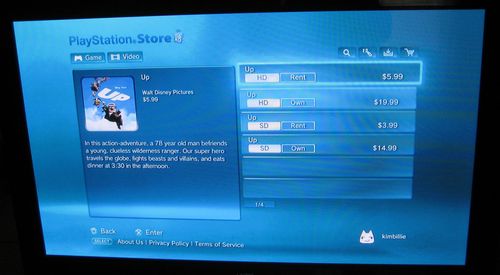
Playstation_3 (Updated Below) Sony just announced that 20th Century Fox, Walt Disney Pictures, Paramount Pictures, Sony Pictures Entertainment, Universal Pictures, and Warner Bros have all agreed to allow Sony to stream their movies over the PlayStation Network to users of the PS3. The service, which launched today, is only available in the U.S. but will be expanded to consumers in U.K., France, Germany, and Spain.

The PlayStation Network is the first gaming console to offer high definition movies from all of the major movie studios and consumers will have the option to either buy or rent HD titles. There's no word as to how many titles the studios will be make available or how quickly they will be added, but Sony did list 18 new movie releases in the press release from all six studios that are available today. (Updated: Sony says they currently have more than 1,200 titles in HD for rent and or purchase and are constantly adding new titles.)

I've had the chance to jump on my PS3 system and rent some of the movies and they quality looks really good. While I can't tell the bitrates they are encoded at and am waiting for Sony to get back to me with a lot of the technical details, so far, I don't see anything here that consumers won't like. (Updated: Sony says the videos are encoded in MPEG4 with SD being at 2Mbps and HD at 8Mbps.) Pricing on the new titles I saw (see below) were $3.99 to rent in SD or $5.99 to rent in HD and $14.99 to own in SD or $19.99 to own in HD. I still think the price to own movies on all devices is too expensive and that most consumers will rent movies anyway and I expect that even rental prices will come down over time.

IMG_2152

I'll post more details on the technical side of the streaming offering as soon as I get them from Sony.

ESPN To Use MLB To Stream All Their Events, Drops Support For Move Networks

ESPN3.com Yesterday, ESPN announced that when ESPN360.com relaunches on April 4th as ESPN3, Major League Baseball Advanced Media (MLBAM) will take over all of the technical support and infrastructure requirements for the new site. EPSN3 plans to broadcast more than 3,500 games this year and will now rely on MLBAM to handle all of the video workflow using the same platform used for MLB.TV.

In a call yesterday with John Kosner, SVP of ESPN Digital Media, John said the deal with MLBAM is a straight services contract with no sharing of ad revenue of any kind. For ESPN, this ends their reliance on technology from Move Networks and now gives them access to all of the functionality that MLB.TV has in their video player. This is a smart deal for both companies as ESPN goes from having to use multiple vendors to stream their events to one provider that handles everything and as a result, John said ESPN’s costs will go down. In addition, users will no longer be required to have to download a Move Networks plugin and can now rely on Adobe’s Flash platform. And for anyone who has used MLB.TV, they know that MLB has some of the best quality video and technology hands down.

This isn’t the first time the two companies have worked together and John pointed out that ESPN and MLBAM have worked on projects with one another over the past seven years. It’s also a good example of two companies that some say compete with one another, actually working with one another.

ESPN3 is only available to consumers if their ISP has licensed access to it from ESPN and John said ESPN3 will reach 50M households in the U.S. this year. While I asked if ESPN plans to offer any kind of subscription based service for consumers who ISP hasn’t licensed the platform, John says ESPN has no plans to do so.

Another interesting aspect here is that many of the pro sports leagues now seem to be moving to the same video platform, that being Flash. MLB.TV use to use Silverlight and moved to Flash some time again. ESPN is now moving from Move Networks to Flash, the NBA already uses Flash and I hear rumors that the NFL will be moving away from Move Networks this year and over to Flash. I’ve asked the NFL for an official comment on this and will update the post if they give me one.

Enterprise Webcasting Provider IVT Announces Jim McGovern As New CEO

This morning, SaaS based webcasting platform provider IVT announced the appointment of Jim McGovern as the company's new CEO. Jim replaces Greg Pulier who was acting as the interim CEO after former CEO Phillip Whalen stepped down last year. Jim was most recently the CEO of itzbig, an interactive job board and he spent six years as CEO of Marketwire. Last month IVT also announced they had a raised a B round of funding in the amount of $5.5M.

A Detailed Look At VUDU’s Streaming Technology, And What It Means To Walmart

Vudu_logo When Walmart announced it had acquired VUDU, quite a few discussions were taking place on the web suggesting that Walmart would now need to setup a data center to be able to handle the delivery of videos or that Walmart wasn’t going to want to support VUDU’s P2P based technology. Since neither of those assumptions are accurate, I thought it might be helpful to detail what video technology VUDU is using and how they encode and deliver content to devices.

For anyone like myself that has an original VUDU device, videos are still delivered using P2P technology that is enabled by the fact that the devices have built in storage. But starting last year, VUDU decided to get out of the hardware business and has been working to get their VUDU platform embedded into as many third party devices as possible and now has deals with LG, Mitsubishi, Samsung, SANYO, Sharp, Toshiba and VIZIO. For these broadband enabled devices, VUDUs P2P technology is not being used since most of those hardware models have no internal storage. That might change over time if SD memory or hard drives get included in TVs and Blu-ray players, but for now, VUDU can’t use their P2P technology for the delivery of videos.

Today, VUDU uses both Limelight and Akamai to deliver their videos to third party devices and encodes all of their content in H.264 for SD, HD and VUDU’s proprietary HDX quality. For each quality classification, VUDU is doing multiple encodes which takes advantage of their own in-house adaptive streaming technology for the delivery. SD quality videos are encoded at 1Mbps, 1.5Mbps and 2Mbps. 720p HD content is encoded at 2.25Mbps, 3.75mbps and 4.5Mbps. 1080p HDX videos are encoded at 4.5Mbps, 6.75Mbps and 9Mbps. While VUDU encodes using the H.264 standard, they spend a lot of time to optimize their videos by using an open-source video encoding platform that they have made a lot of modifications to. This is one of the reasons why people who use VUDU, including myself, think they have the best looking videos today. To me, VUDU’s 1.5Mbps stream looks much better quality wise, than Netflix’s 1.5Mbps stream and has some of the fastest start times I have seen, outside of 1080p streaming on the Xbox 360.

In addition to VUDU streaming all of their media, they also are the only one that I know of that streams their entire UI. Since their UI is not inside a web browser, the VUDU application actually sits in the cloud and as a result, their architecture enables them to update their application very quickly. This is very different when compared to devices with embedded software that requires a lot of effort to manage. When your app sits in the cloud, your not writing software and instead, are simply authoring just like you would if you were updating a website. This is one of the reasons how VUDU is able to integrate with Rotten Tomatoes, Wikipedia and last week launched support for Twitter and Facebook.

Some folks have said that with VUDU being forced to abandon their P2P platform, and given the bandwidth required to distribute their premium HDX movies, VUDU’s cost structure drastically changes for the worse. Some have implied that this will force Walmart into making a big infrastructure investment to support the distribution of videos, but that’s not accurate. Since VUDU already uses third party CDNs, they don’t need to make any kind of large investment into VUDU’s delivery capabilities. And while VUDU created their P2P technology years ago to circumvent the high price of delivery, today, the price of delivering movies has drastically fallen from years ago with the average movie now only costing a few cents to deliver.

As a user of VUDU and just about every other movie service available today, I’ve always felt that the VUDU platform and quality were very good, with a great user-experience. While VUDU would have already been dead if they had not changed their business model last year and gotten out of the hardware business, getting acquired by Walmart certainly breathes new life into the company. But I’m still skeptical that Walmart is going to know what to do with the business and will give VUDU the resources they need to be successful in the market. While I could be wrong, Walmart just doesn’t have a good track record of understanding the digital media landscape.