Free Giveaway: Win One Of SIX Roku XDS Units At The Broadband Device Pavilion

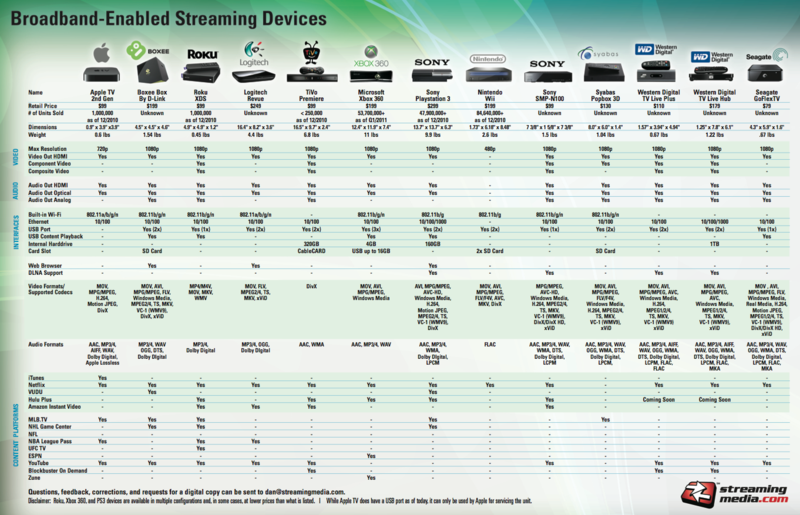
IMG_0321 Thanks to the very generous folks at Roku, I have six Roku XDS units to give away next week at the Broadband Device Pavilion in NYC. All you have to do is stop by the pavilion and enter the drawing. We'll also be giving away prizes from Logitech, MLB.TV, Apple, Netflix, Xbox, Boxee, VUDU, Western Digital and others.

The Broadband Device Pavilion is your chance to get hands on with devices and platforms from: Apple, Roku, Microsoft, Netflix, VUDU, Blockbuster, Sony, Vizio, Samsung, Western Digital, Seagate, Boxee, TiVo, Nintendo, HBO, Hulu, Amazon, ESPN, EPIX, Toshiba, BlackBerry, LG, Sharp, OnLive and more.

This is your chance to compare all of these devices and platforms in action, side-by-side, and check out what each platform offers in the way of content and video quality. All you need to do is register online for a FREE exhibits pass and you'll have complete access to the Broadband Device Pavilion, plus all the keynotes, networking events and exhibit hall.

6a00d834518e1c69e2015432133e70970c-800wi

Sponsored by

MLB.com Now Using Level 3’s CDN For Video Delivery, Akamai No Longer Sole CDN

Over the past few weeks I have been doing a lot of trace routes to see where video is being delivered from some of today's largest M&E customers. While tracing content from MLB.com, I noticed that Level 3 is showing up more often than in the past and yesterday, on Level 3's earnings call, the company stated that MLB.com now uses Level 3's CDN for video delivery.

While Level 3 has been a network and co-lo partner to MLB.com for some time, MLB.com was not using Level 3's CDN until recently. MLB.com would not give out details on the current split of traffic between Akamai and Level 3, but a person I spoke to at MLB.com made it clear that the business driver behind using Level 3 was due to the need to provide the best performance possible for end-users and that MLB.com moving some traffic to Level 3 was not due to price.

The announcement of the new customer win by Level 3 comes at an interesting time as Akamai reported during their earnings call last week that the rate of traffic growth on their network from media and entertainment customers had "moderated", but that it was not due to them losing business or wallet share in the market. At the same time, Level 3 said traffic growth on their network was accelerating at a faster rate than at this time last year. Basically, Level 3 is seeing the exact opposite of what Akamai is seeing.

Clearly Akamai is losing some share of their M&E traffic to companies like Level 3 and while MLB.com was the only customer that Level 3 mentioned by name during their earnings call, trace routes I've done from other content sites shows Level 3 as a new CDN in the mix. Do trace routes for videos from Facebook and see where those are coming from. The evidence that Level 3 is winning more business is clearly out there and that means the share has to be coming at the expense of another CDN.

Based on my estimates it looks as if 25-30% of MLB.com's traffic is now going over Level 3's CDN and I expect that to grow to a higher percentage over time. And if Level 3 does clear all of the regulatory hurdles in their planned acquisition of Global Crossing, Level 3's CDN network will only get stronger internationally. The bottom line is that Level 3's wins are coming at the expense of another CDN, or multiple CDNs.

Updated 9:27am: Someone pointed out to me that all of the small objects for Twitter are now being delivered from Level 3, in what looks to be the exclusive CDN. I don't know who Twitter was doing this with in the past, but maybe someone else knows more details.

Updated June 6th: Here is the press release announcing the deal.

Debunking HTML5 Video Myths: A Guide for Video Publishers

Now that Google has made the decision to remove H.264 from Chrome, it’s more important than ever to pick the right video formats for online video distribution. Many claims about HTML5 have been laid down by both standards and Flash proponents, and not all of them are based on fact.

At the Streaming Media East show, on May 10th and 11th, we’ve got Robert Reinhardt, author of over a dozen books on Adobe Flash doing a presentation on “Debunking HTML5 Video Myths: A Guide for Video Publishers” as part of our HTML5 track. In this session, Robert will walk you through the capabilities of HTML5 and the Flash platform as well as the codecs they support, including WebM and H.264. Learn the effect HTML5 will have on video encoding and distribution in the future and how HTML5 may impact your business.

It’s not too late to get a pass to the show and readers of my blog can register using my own personal discount code of DAN, which gets you a two-day ticket to the show for only $695. Twitter hash tag: #SMEast

Join Me For Cocktails & Content Delivery: Special Reception For Wall Street Investors May 9th

Glg_r Following the Content Delivery Summit on Monday May 9th, Gerson Lehrman Group is holding a special networking reception from 6-7:30pm for Wall Street investors at a restaurant near the Hilton hotel. I'll be there with special guests from the summit providing a recap of important trends affecting content delivery networks, carriers, MSOs, and content owners as it pertains to Wall Street investors.

Wall Street investors interested in attending the private event should email Ken Andersen at GLG for additional details.

Learn All About HTML5 And Web Video Standards

As video becomes increasingly important on the web, content providers, browser developers, and end users can no longer afford to have the primary video delivery mechanisms locked up in standards that cannot be adapted to new environments.

At the Streaming Media East show, on May 10th and 11th, we've got Tim Napoleon, Co-Founder and President of Alldigital moderating a panel entitled "HTML5 And Web Video Standards" as part of our HTML5 track. In this session, speakers will examine what HTML5 video is, the challenges it's facing, and how it affects other formats such as Flash and Silverlight, as well as how leading platforms and web giants such as Google, Mozilla, and Apple are supporting it.

  • Moderator: Tim Napoleon, Co-Founder, President, Alldigital
  • Sy Choudhury, Director, Product Management, Web Technologies, Qualcomm
  • Joe Inzerillo, SVP, MLB.com
  • Erin Quist, VP, Publisher Solutions, EyeWonder
  • Ben Rolling, VP, Development, AEG Digital Media

It's not too late to get a pass to the show and readers of my blog can register using my own personal discount code of DAN, which gets you a two-day ticket to the show for only $695. Twitter hash tag: #SMEast

Wall Street Questioning Akamai’s CDN Business After Company’s Q1 Earnings Call

When Akamai announced during their Q1 earnings call last week that the rate of traffic growth on their network from media and entertainment customers had “moderated” for the second quarter in a row, many on Wall Street were left scratching their head about what’s causing the decline. Since then, I’ve gotten a lot of calls and questions about this and while only Akamai knows for sure what’s causing the decline in traffic growth, here is what I am hearing about traffic patterns from speaking to content owners and other CDN providers.

Some analysts I spoke to were quick to say that Akamai isn’t losing wallet share to competitors, which would be one of the obvious ways for any CDN to quickly see a decline of traffic growth on their network. While this may or not be the case (we don’t truly know since Akamai does not disclose how many CDN customers it has from one quarter to the next), Akamai did say that when it comes to renewals, “it’s a very competitive space out there, especially in the volume-driven solutions” and that, “competition has something to do with it,” with regards to pricing for renewals.

But whether or not Akamai is actually losing wallet share with CDN customers I can’t tell. Each quarter I see Akamai lose some contracts to competitors but then I also see them take business from the same competitors, in the same quarter. Without knowing how many CDN customers Akamai has, especially for video, and what percentage of revenue those customers make up, putting percentages on wallet share is a guessing game. But if Akamai is not losing wallet share, why is traffic on their network not growing as fast as previous quarters? Even if pricing is lower, that would not impact the rate of traffic growth, it would only impact revenue.

If other CDNs were seeing the same decline in traffic growth, then this would all make sense. But so far, all of the CDNs I have spoken with aren’t seeing the rate of traffic growth on their network decline, they are seeing the opposite. And content owners keep telling me their traffic is growing at a faster rate than last year. In fact, six days before Akamai’s earnings call, one of Akamai’s larger CDN customers, MLB, put out a press release detailing just how fast their traffic grew this year when compared to last. Even Akamai gave out traffic numbers for the March Madness tournament saying there was a, “63% increase in total visits over 2010“. So with Akamai having a lot of large M&E customers like MLB.com, whos rate of traffic growth is accelerating, why isn’t Akamai seeing that on their network? It’s puzzling.

When it comes to revenue, Akamai did say that revenue from their media and entertainment customers, “declined 4% sequentially in the first quarter, driven by contract renewals at lower price points from some of our largest media customers.” That all makes sense and why this has spooked some on Wall Street I don’t know as it’s not uncommon that Akamai would have to cut pricing for contract renewals with some of their largest customers. That’s simply the nature of the business, but pricing declines does not explain traffic growth declines. If anything, a cheaper price means that a customer should push more volume, not less, since this is a volume based business. And in order to even get the lower pricing, customers have to show they are growing traffic at a faster rate to qualify for a discount.

Akamai did say that they, “remain confident in the long-term growth potential” for their “volume business” and while that is good, it still does not explain why they have reported what they have over the past two quarters. So what exactly is going on, I don’t know, but here’s what you want to keep an eye on. Level 3 reports earnings today and Limelight reports earnings on Thursday and if neither one of them talks about the rate of traffic growth slowing on their network, then Wall Street is going to question Akamai even more on what they reported.

If Akamai is in fact losing some wallet share, expect them to lower their pricing again to get that market share back. We saw this in 2009 when they cut pricing and then their M&E revenue grew nicely for a few quarters after and we just might see them have to do it again. Akamai set the tone last quarter when they talked about a reset in pricing, but most thought that the volume commits or the expected volume associated with those renewed contracts would drive acceleration in traffic growth faster than it is.

Content owners have been pretty open discussing with me their rate of traffic growth and tell me that on average, they expect traffic to grow about 60% this year, which would be higher than the 45-50% rate of growth they saw last year. If that numbers sticks, and it’s too early in the year to know for sure, Akamai “should” make out ok in the second half of this year. But if Limelight and Level 3 don’t discuss any kind of traffic growth slowdown on their earnings calls, then Akamai is really going to have a hard time convincing Wall Street that they can grow their volume based business in the second half of this year.

Updated 3:31pm ET: During Level 3’s earnings call, the company said they are not seeing any rate of decline in the growth of traffic on their network. If Limelight says the same thing during their earnings call on Thursday, then it’s clear that Akamai is in fact losing wallet share.

The Term “HD” No Longer Means Anything, Lowe’s Offering “Hi-DEF” House Paint

Signature-hi-def I’ve been saying for a few years now that there aren’t really any standards when it comes to classifying what is considered to be HD quality video on the web. We see terms like “high quality” and “high definition” used, but content owners and vendors have not agreed on any kind of metric to define what classifies a video as HD quality.

Showing just how generic the phrase Hi-Def has now become, over the weekend I saw a commercial for Lowe’s “Hi-DEF” paint. Does ordinary paint only have 480i lines of resolution? Apparently Lowe’s classifies their paint as HD because it has “super saturated pigments” and with a primer mixed in offers “maximum coverage.” Too funny. Maybe if I brush my teeth with Crest’s 3D toothpaste and stare at Lowe’s paint long enough, I’ll get a 1080p experience. American’s are too gullible.