Latest CDN Pricing & Volume Data To Be Presented May 14th at The Content Delivery Summit

Default_ConfIn less than two weeks, the fourth annual Content Delivery Summit will take place in NYC on Monday, May 14th. The event will bring together telecom carriers, service providers, content owners, and industry vendors for a detailed look at CDN platforms for the delivery of video and content acceleration.

I've recently completed a CDN pricing survey and collected data from over 500 customers that use content delivery networks for the delivery of video. At the Summit, I will share the latest data collected from the survey along with details on the size of the content delivery market for video, as well as expected growth forecasts for both revenue and traffic volumes.

Attendees will also learn the current pricing points for video delivery services and hear about the market drivers and trends that will determine what customers pay in the future. There will also be an extensive Q&A session, so this is your chance to ask questions pertaining to current or future CDN pricing and market drivers.

The summit will also feature presentations and discussions pertaining to federated CDN, licensed and managed CDN, front-end optimization, transparent caching, optimizing web applications, telco and MSO CDN deployments, build vs. buy, over-the-top video and others.

It's not too late to get a pass for the event and you can use the special registration code of DRF01 and get access to the keynotes, all of the sessions, presentations and networking events for only $295. Register here and put the code DRF01 in the box at the bottom. Twitter hash tag #cdnsummit

Sponsored by

Here’s Your Chance To Win 1 of 12 Google Chromebooks at The Streaming Media East Show

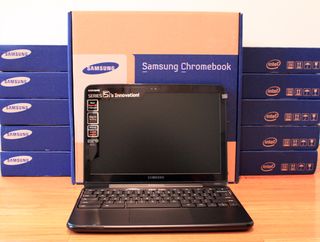
IMG_5272Thanks to Google, we're giving away 12 Samsung Chromebook Series 5 laptops at the Streaming Media East show, taking place May 15-16th in NYC. To attend the Google keynote on May 15th, simply register online for a free exhibits pass and you are in. After the keynote, attendees will have the chance to win one of these laptops. An extra special thanks to Google for being so generous with the giveaways!

It's not too late to get a full conference pass to the show and readers of my blog can register using my own personal discount code of DRF01, which gets you a two-day ticket to the show for only $445. #smeast

Streaming Media East Conference to Feature 20 “How-To” Sessions

We heard our attendees loud and clear. They said "talk less, show more" and at this year's Streaming Media East show, we're making that happen. We've added a fourth track devoted solely to "how-to" sessions. Plus, several others sprinkled throughout the program. The how-to sessions include:

  • How-to: Technical Setup of Live Streaming Production
  • How-to: Choosing an Enterprise-Class Video Encoder
  • How-to: Encoding Video for iDevices
  • How-to: Social Video, Techniques to Make Your Videos Go Viral
  • How-to: Video Player Development Across Multiple Screens
  • How-to: Low-Cost, Live Captioning for Webcasting
  • How-to: Comparing & Configuring Live Streaming Encoders
  • How-to: Optimizing Video for HTML5 and Flash
  • How-to: Enterprise Video Case Studies
  • How-to: Device Demos, Battle of the $99 Streaming Boxes
  • How-to: Encoding Video for HTML5
  • How-to: Multi-Bitrate and Multi-Screen Streaming With Flash Media Server 4.5
  • How-to: Adaptive Live Streaming to Any Device From a Single Encoder Stream
  • How-to: Building an HTML5 Video Player
  • How-to: Device Demos, Battle Of The $99 Streaming Boxes
  • How-to: Best Practices for Planning A Content Curation Strategy

Plus – Monday's Preconference Workshops:

  • Streaming Media Delivery – Servers and Clouds
  • Encoding for Flash, Mobile, and HTML5
  • Live Webcasting from Soup to Nuts
  • Planning Online Video Deployment for HTML5 and Flash

You can find out more about all of our sessions here and use the discount code of DRF01 to get a full conference pass for under $500.

Hands-On Review: D-Link’s MovieNite Streaming Player Not Worth Buying

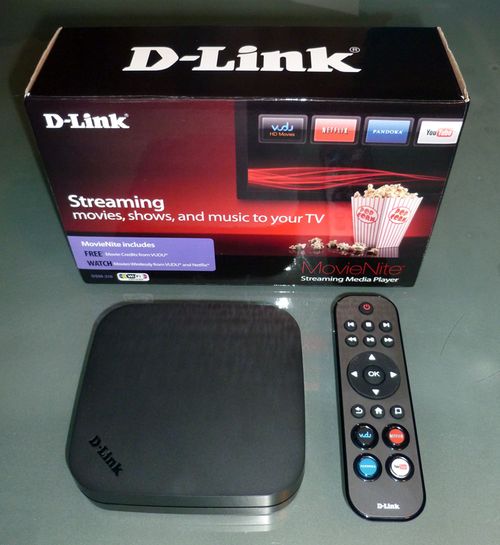
P1010081Over the weekend I picked up the new D-Link MovieNite streaming media player, a $48 box developed in conjunction with Walmart and sold exclusively in their stores and via the Walmart.com website. Of all the streaming media devices I have reviewed and tested, I don't think I've ever told readers not to buy something, until today. For what is suppose to be a very simple player aimed at a non-techie crowd, this player falls far short in just about every category and is not worth the money.

The player supports 1080p video streaming and has 802.11n WiFi, 10/100 ethernet port, HDMI out and composite video connections. The player only supports content from Netflix, Vudu, YouTube and Pandora and has no support to play back local content via USB and no slot for any kind of memory card. While some of those shortcomings would be just fine for someone who only wants to use it to stream movies and TV shows from Netflix and Vudu, I'm afraid even those simple tasks are painful with this player.

The box supports 802.11n, yet no matter what I tried I could not get it to connect to my WiFi network. Another issue is that the name of WiFi networks are cut off, with my network only showing up as two letters in the name, out of seven. Putting in a call to D-Link's tech support number was no help as they couldn't solve the problem. My router sits ten feet from the box, has ten other devices that can connect to it via WiFi, yet the D-Link player kept telling me it could not connect to the network. D-Link support had me reset the box over and over again, with no luck. They then asked me to wait on hold for at least 30 minutes while they "called headquarters", but I declined to wait. On a side note, I know that most companies these days outsource tech support calls to foreign countries to save money, but trying to diagnose a tech issue, with someone who does not speak English fluently, is never a good user experience.

Hoping my WiFi issues were just a software problem that could be resolved with a firmware update, I tried to update the box under the maintenance option, but was given an error message of "Memory space is not enough for upgrade! Do you want to reboot now?" So if you can't download updates for the box, I'm not sure how D-Link expects to ever add fixes and features? For my last option, I actually broke out the printed three page Quick Install Guide in the box, but that was useless. But I did get a good laugh when step three told me not to plug in an ethernet cable if I wanted to use WiFi as the "on-screen setup wizard will allow you to configure your wireless settings". Now I get what they were saying, but if this box is really targeting non-techie's, step four should not be telling you to plug in the power supply when step three is talking about an on-screen setup wizard.

Giving up on trying to connect the box via WiFi I plugged in an ethernet cable which saw my network right away. Since the box only supports four content services, the remote has dedicated buttons for Netflix, Vudu, YouTube and Pandora. The bad news is that the software interface for this box is slow and buggy. Netflix takes nearly twenty seconds to load and videos take much longer to start up when compared with the Roku or WD TV Live player. D-Link does have a note on their website saying that they have released a product software update that resolves issues with streaming content from Netflix, but they don't say what issues they are fixing and there is no way to force download the update.

To get the update on the box D-Link says to "reboot it by powering it off and then back on, wait for the update message to appear, and select ok." Problem is I don't get that message when I reboot it and I have no way to know if that means I already have the update or not. The entire user-experience with this product was not well thought out and it's a really poor interface. I don't know why this box is so slow, but there is a lot of lag time with the software and the box froze on me twice, forcing me to pull the power plug.

Overall, there is nothing to like about this box and consumers would do far better spending $30 more for a Roku HD. And if 1080p isn't required, you can get a Roku LT for the same price as this box, which will also give you hundreds of content channels, instead of only four. The only advantage D-Link's MovieNite box has over Roku is their support for YouTube, something Roku is still missing for some unknown reason.

While I could understand D-Link and Walmart's desire to want to put out a really cheap streaming box in the market for those who just want to stream Netflix and Vudu, it's really pointless when every connected TV, Blu-ray player and streaming box already has Netflix on it. This box really doesn't fill any void in the market and isn't worth buying.


Data Shows Video Accounts For 60% of MSO and ISP Traffic, 50% Of That Comes From Netflix

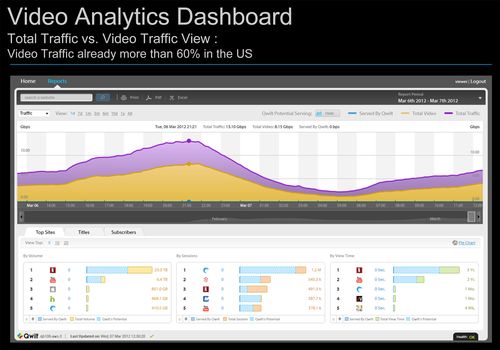
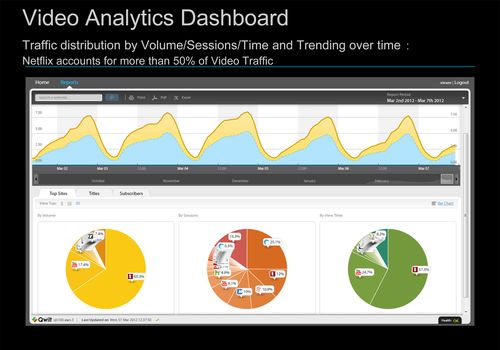
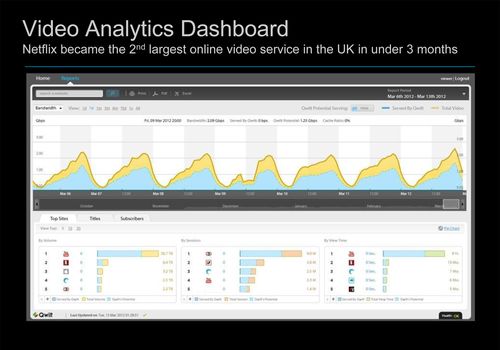
In a recent discussion with transparent caching provider Qwilt, the company shared with me data from some of their ISP and MSO customers in the U.S. and Europe. At one major MSO in the U.S., 60% of their traffic comes from video content. Netflix makes up 50% of that traffic and also leads in total viewing time.

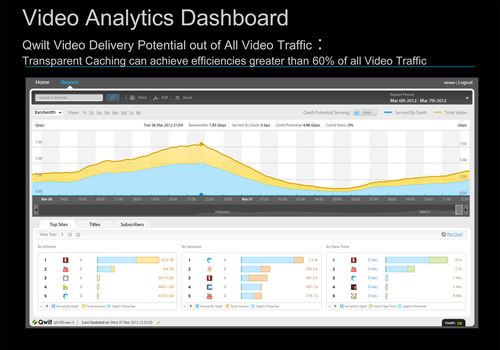
And from a major ISP in Europe (see charts below), Netflix become the second largest online video service in the UK in under three months. While the BBC iPlayer has the second largest online video volume in the UK, they are currently migrating their platform to HTTP from RTMP which is the reason you don't see them in the top sites graph.

While these numbers should not come as any surprise to those who talk to MSOs, ISPs and carriers, it is further evidence that transparent caching solutions and licensed and managed CDN platforms are starting to play a very crucial role with those who own and operate the last-mile networks.

We'll be discussing and hearing directly from MSOs and carriers on this topic at the Content Delivery Summit next month.


1
2

3 4

Video News Roundup From Day Two Of The NAB Show

Netflix’s CEO Is Trying To Use Net Neutrality To Deflect The Real Issue, Competition

On Sunday, Netflix’s CEO took to his Facebook page to complain that Comcast isn’t being fair when it comes to net neutrality principles. His argument is that Comcast’s Xfinity TV streaming app on the Xbox 360 doesn’t count towards consumers monthly bandwidth cap, yet services like Netflix and Hulu do. While it’s a nice try on his part to drag net neutrality in the subject and get people all worked up, he’s simply trying to deflect away from the real issue at hand, which is the competition Netflix is facing from Comcast and others.

For their part, Comcast says Xfinity does not count towards consumers 250GB cap per month because the Xbox 360 acts as an additional cable box for your existing cable service. No matter which side you take, the point that is being missed is that today, Comcast’s cap doesn’t matter. Comcast has said that less than 1% of their customers go over their 250GB cap each month. And based on Reed’s own post on Facebook, a one hour show takes up about 1GB of data. That means a user would have to consumer 250 hours of video a month, or 8.3 hours per day, encoded at 2.5Mbps in order to go over their cap.

Netflix could back up their argument by saying how many of their customers use Comcast and what percentage of them go over their cap, but of course, they won’t say. Because if they did, the real numbers would be so small it would not reinforce their argument. When was the last time you heard Comcast customers complaining their cap was “too small”? Almost never. And those that have gone over their cap, the vast majority of them never get charged overages. Just look a the comments on chat boards like DSLreports.com and others. Comcast has a cap in place so they can enforce it if they need to, for those that abuse the service, but most users who have done 300GB or 350GB a month haven’t been charged overages at all.

If Comcast does not raise their caps over time as consumers use more data, then that could be an issue and could affect a larger percentage of subscribers. But the fact is, today, the cap is not impacting the market or keeping content owners like Netflix from growing. Caps are something consumers in the U.S. don’t like as Americans don’t like being told they can’t do something. They want all you can eat for a fixed cost, which is evident by how well Netflix has done in signing up subscribers for a flat fee per month.

If caps are such a big issue like some want to make them out to be, then consumers should be happy that Comcast is allowing them to stream more content from Xfinity TV, without it counting towards any kind of cap. Isn’t that what consumers want? To be able to stream more content and not have to pay for it? Of course Netflix will argue that this kind of tactic could lead to MSOs deciding which content get priority, which is what net neutrality is all about. But Netflix’s CEO doesn’t really care about Comcast’s cap, he cares about how this could impact his costs. I challenge Netflix to share data with the industry that shows a large percentage of their consumers are going over their caps. Where is the data to validate their point? To date, Netflix won’t give out any real details on the consumption of their service, other than to talk about high-level numbers like total minutes of TV shows and movies streamed in a quarter.

Bringing this back to Netflix’s argument that this is a net neutrality issue, if you look at what net neutrality is about, this is not it. Net neutrality principles say that all traffic originating on the Internet be treated equally. But streaming Xfinity TV on the Xbox 360 originates from within Comcast’s own network and not from the Internet. Netflix and others are confusing “neutral” with give Netflix a free way to access the Comcast network. Now I don’t agree that Comcast should charge more to CDNs like Level 3 just to turn up ports on their network, but this Netflix argument really has absolutely nothing to do with anything “net neutrality” related. It’s simply Netflix trying to deflect from things like their stock being downgraded, their churn getting higher and more competition starting to impact their growth.

When Netflix was flying high, with no competition, you never saw them whining in the market and their CEO wasn’t complaining on his Facebook page. The company was focused on making their service better and doing a good job with customer service. They should go back to focusing on those things again.

Disclaimer: I have never bought, sold or traded stocks in any public company ever. I have a FiOS triple play bundle with Verizon and am not a customer of Comcast. I have been a customer of Netflix for many years.