Akamai Said To Be Guaranteeing AT&T $100M In CDN Reseller Deal

At the end of last week, and over the weekend, multiple people from the industry were sharing with me what they know about the negotiations between Akamai and Limelight, who are both competing for a CDN reseller contract with AT&T. Everyone I spoke with said they expect Akamai to win the contract and all of them also said that as part of their proposal, Akamai is guaranteeing AT&T at least $100M in revenue, over a multi-year deal. Some people told me the deal size was $100M and others said it was “more than” $100M, but either way, it sounds like Akamai has put forth the best revenue numbers.

While $100M may sound like a lot of sales, when it is spaced out over a couple of years, it’s really not that much revenue for AT&T. But I’m also hearing that Limelight was only willing to guarantee half as much revenue to AT&T, between $40-$50M, which if true, it’s probably one of the reasons why everyone I speak to keeps saying Akamai will win the deal. Of course, until a contract is signed, none of this is official and we still need to see AT&T execute on this new strategy. Companies put a lot of ideas and plans on paper, without following through with them, but from everything I am hearing, it sounds as if AT&T is looking to wrap this up pretty soon and sign a contract with Akamai or Limelight.

Sponsored by

Here’s The Four Hottest Upcoming Streaming Devices You Should Know About

There are a lot of streaming media devices out in the market right now from tablets and game consoles to stand-alone streaming boxes and connected TVs. While I have, use and test consumer streaming services across more than 50 devices, there are a few new devices that have just come out or will be coming out shortly that I am excited about. Here what those devices are and why I can’t wait to get hands-on with them.

Vizio Co-Star

Vizio’s Co-Star streaming box could challenge Roku, Apple TV and the WD TV Live as the most full-featured $99 streaming box in the market, which just started shipping in the past 24 hours to those who pre-ordered last month. The box has built-in ethernet, WiFi, two HDMI ports (in and out), DLNA support, one audio IR port and has USB to support the playback of local content. The box supports 1080p video quality and also supports 3D streaming and will have an app for OnLive’s gaming service. On the content side, the box comes bundled with the Google TV platform which Vizio has completely re-skinned, thereby creating a new user interface for the Google TV platform. In addition the box supports content offerings from Netflix, YouTube, Amazon Instant Video, HBO GO, Wall Street Journal, Pandora, iHeartRadio, Slacker Radio, M-GO video-on-demand and other content services not yet announced.

Included with the box is a bluetooth touchpad universal remote with QWERTY keyboard. Vizio says the idea with the all in one remote is to allow customers to connect cable or satellite set-top boxes through the player’s built-in HDMI ports for a smoother experience for the overlay of live TV. Over the years, a lot of companies like D-Link, Sony and Netgear have come out with their own $99 boxes in an effort to compete with Roku and Apple TV and so far, don’t have a lot to show for it. But Vizio’s Co-Star box is very different since none of the other $99 boxes come bundled with the Goolge TV platform, have HDMI pass-through and most don’t have DLNA support. It’s one of the reasons that Vizio’s box is on the top of my list of devices I’m really excited to see in the market.

Simple.TV

Simple.TV is a HD Tuner and DVR video server in one simple package. Announced at CES in February, and slated to ship by the end of this year, Simple.TV allows consumers to connect an external USB hard drive for storage, plug-in a TV signal from their basic cable or over-the-air antenna and connect the box to their home network. They offer free apps for the iPad and Roku with more on the way and plan to offer an enhanced service for $4.99 a month. The premium service will give consumers access to a rich interactive program guide, unlimited remote streaming for up to five users and an easier way to record TV shows automatically. The device is expected to ship by the end of this year and retail for $149.

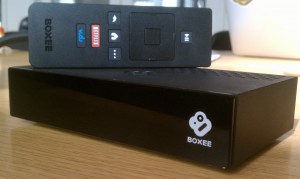
To date, a lot of boxes on the market allow you to stream content or place-shift it to another device, but none of them give you any DVR style functionality. Some like Boxee do support over-the-air antennas, but doesn’t have a program guide tied into any kind of DVR style services. It’s too early to know how successful the Simple.TV device will be, but from my conversations with the founders of the company, they are hoping to sell a few million devices over the first few years, which is pretty realistic.

Roku Streaming Stick

The Roku Streaming Stick will be the easiest way to take a dumb TV and turn it into a smart TV. The Streaming Stick plugs directly into the MHL port on newer TVs and feeds video to the HDTV, accepts remote control inputs and power, and brings its own WiFi support for Internet access. Roku hasn’t yet disclosed the cost for the stick or when it will ship, but they have indicated that they’ll release more details in a few weeks. Roku’s already got a nice box on the market that’s only $49, but this streaming stick allows you to add Internet functionality and content to any TV with no wires or boxes, something a lot of consumers would appreciate.

The company has already announced a list of manufacturers that will deliver Roku Ready hardware and I expect we’ll see that list grow. To date, the way to get a smart TV was to buy a new one or get an expensive box giving you Internet access, but not real user-interface. If Roku can create a very easy way to navigate the big screen, along with an intelligent easy and to use user-interface, the Roku Streaming Stick should be a big hit, especially if they sell it for as cheap as I think they will. (think $30)

Belkin @TV Plus

[Updated: I’m hearing Belkin has confirmed that this device will only output 480p video. Based on the lack of HD support, this device is nothing to be excited about] Belkin’s @TV Plus is looking to go head-to-head with the Slingbox PRO-HD, which allows you to stream your live cable TV service to multiple devices. I love my Slingbox Pro and it is by far the best device in the market today for a true TV everywhere experience. I have access to my full channel lineup and my DVR from my computer, tablet and phone. But the one shortcoming of the device is that is has no built-in WiFi, so you need to have it close to your router, drop an ethernet jack into your wall, or use some sort of adaptor to push your Internet signal via your electrical outlets. Belkin’s @TV Plus has built-in WiFi, so that should make setup much easier and allow you to really extend where you can place the units, which is something I have had problems doing with the Slingbox PRO.

Another advantage of Belkin’s @TV Plus device is that they don’t charge for their tablet app, something Sling makes you pay for. Belkin does charge $12.99 for the mobile app, but that’s much cheaper than Sling’s price of $29.99 for their mobile app. Belkin’s device is also cheaper than the Slingbox Pro-HD, currently selling on Amazon for $179.99, compared to the Slingbox PRO-HD which is priced at $249.99. The lower price for the unit and the apps is welcomed, but only if they work as well as Sling’s apps do and can match the level of video quality produced from the Slingbox PRO-HD. Belkin’s @TV Plus started shipping this month and while I haven’t yet had the chance to test it out and see how good it is, I hope to have a review up shortly.

What streaming media devices are you interested in seeing this year?

Want to see how the current streaming media devices in the market stack up? Check out our device comparison sheet at www.StreamingMediaDevices.com

Netflix’s Expansion Across Europe Targets 22M Internet Users

This morning, Netflix (NFLX) announced they plan to roll out streaming services to consumers in Norway, Sweden, Denmark and Finland by the end of this year. Based on the number of Internet users in those regions, Netflix is targeting about 22M connected consumers. Here’s how that breaks down per region (numbers based on data from the ITU).

  • Sweden: 8,441,718 Internet users on Dec.31, 2011, 92.9% penetration rate
  • Finland: 4,661,265 Internet users as of Dec.31, 2011, 88.6% penetration rate
  • Denmark: 4,923,824 Internet users as of Dec.31, 2011, 89.0% penetration rate
  • Norway: 4,560,572 Internet users as of Dec.31, 2011, 97.2% penetration rate

To get subscribers, Netflix needs content for these new regions, specific to what consumers want to watch in these countries. But they have the chicken and the egg problem. To get subscribers, Netflix needs content. To get content, Netflix has to pay the studios which requires subscribers. Netflix is having to commit to up front massive payouts to studios for whatever content they can get. But if subscriber growth stagnates, Netflix could quickly find itself upside down in those agreements. From a financial perspective, Netflix has already estimated it won’t be profitable next year as they expand into new territories in a clear sign that content costs are skyrocketing.

The good news is that there are a lot of Internet users in these European regions and their broadband speed is pretty high. The exact speed per country depends on which stats you look at, but the average looks to be at least 5Mbps, which is plenty for Netflix’s streaming service. Netflix has their work cut out for them in terms of licensing the right kind of content for these regions and that will determine how successful they can be in signing up new subscribers. So far, the company hasn’t done a good job with their content licensing strategy in Latin America, so one has to hope they have an easier time in these new European countries.

AT&T In Talks To Re-Sell Akamai or Limelight’s Enterprise CDN Services

After many years of AT&T (T) trying to sell their own CDN services into the enterprise, multiple sources tell me that AT&T has decided that it makes more sense for them to simply re-sell CDN services from either Akamai (AKAM) or Limelight (LLNW). Both vendors are currently in negotiations with AT&T bidding on the business and while AT&T has not yet picked a winner, I’m hearing that even though Limelight had been favored to win the deal, the reseller business is now Akamai’s to lose.

No deal has yet to be finalized and considering this involves AT&T, who doesn’t have a track record of moving quickly, we’ll have to wait and see if they execute on this plan. From the details I have, Limelight has put forth a better offer business wise but AT&T has more confidence in Akamai’s ability to sell into the enterprise market. While Akamai does have the advantage there, the downside is that AT&T will run into a lot of channel conflicts with Akamai since a very large percentage of enterprise customers are already taking services from Akamai. AT&T would have less channel conflict re-selling Limelight’s CDN services, but to date, Limelight hasn’t had a lot of success in growing their enterprise business.

I’m told that as part of this contract with AT&T, the winning vendor would take on some of AT&T’s employees from their digital media group, so Akamai or Limelight would stand to gain some additional headcount with the contract. While many would be quick to assume that a re-seller contract with AT&T would generate a lot of revenue for Akamai or Limelight, it won’t. At least not in the near term. Last year, AT&T did a total of $10M in CDN revenue and right now, no telco is killing it when it comes to selling their own CDN services, or re-selling those from a third-party. There is a good opportunity to grow the CDN business over time, but it’s over many years and it won’t amount to a large amount of revenue for either Akamai or Limelight over the next 24 months.

While many are familiar with the multi-year contract that AT&T already has in place with EdgeCast, that should not be impacted if AT&T goes through with this new strategy. AT&T has always been using EdgeCast’s licensed CDN platform for their wholesale CDN services and federation model, so I would expect AT&T would still manage this portion of their CDN business. Customers who are currently buying this solution from AT&T purchase it from a wholesale division of the company, not from an enterprise sales team, so a new re-seller deal with Akamai or Limelight should not impact AT&T’s wholesale CDN business, which continues to grow. We don’t know exactly how much traffic AT&T is pushing for this portion of their business, but earlier in the year EdgeCast did say that combined, “multiple operators” are “already pushing tens of Gbps via the CDN federation”. So it sounds like any CDN business already running across EdgeCast, wholesale or not, would not see any disruption.

While enterprise customers could also go direct to Akamai, most of AT&T’s large enterprise contracts are for multiple products, including things like co-location, transit and managed services, which are services Akamai does not offer. So AT&T isn’t trying to get CDN only business with a re-seller deal like this, but rather want to use CDN to keep or get them more of the non-CDN business they already have.

We’ll have to wait and see exactly which CDN vendor AT&T teams up, if they follow through on this new strategy, and how long it would take them to execute such a plan. But it seems pretty clear now that AT&T has finally made the decision not operate their own CDN outside of the wholesale business and that by re-selling Akamai or Limelight, it will give them access to a bigger section of content delivery products and a bigger piece of the pie.

Updated: I did not contact any company mentioned in this post asking for them to comment as I know none of them would have been able to talk about a potential pending deal.

Wednesday’s Webinar: “Best Practices For Live Event Encoding”

Wednesday at 2pm ET I’ll be moderating another StreamingMedia.com webinar, this time on the topic of “Best Practices For Live Event Encoding“. There’s more to getting a live event online than just being there with a camera and an encoder. What efficiencies are you overlooking, and how can you ensure the best experience for the widest possible audience at the best price? What’s missing from your toolbox? Join us for this event and bring your questions as we explore the following:

  • Importance of delivering the right bit rates to the right devices
  • Taking advantage of the medium, multiple camera angles, metadata to highlight key events
  • Monetization – Ad insertion across multiple formats and platforms
  • Accessibility – Captioning and Multiple languages

Register here and bring your questions for the presenters for the live Q&A portion of the event.

Free Giveaway: Win One Of Two Google Nexus 7 Tablets

Right now, in the $200 price range, Google’s Nexus 7 tablet is the one to beat. I’ve got dozens of tablets I use for testing and between the Kindle Fire, Nook Tablet, Samsung Galaxy 2 and Blackberry Playbook, the Nexus 7 tablet outshines them all. This is your chance to get hands-on with the Nexus 7 as I have two 8GB units to give away to some lucky readers of my blog.

To enter the drawing, all you have to do is leave one comment on this post and make sure you submit the comment with a valid email. The drawing is open to anyone with a mailing address in the U.S. and I will select the first winner at random next month. Good luck! The drawing is now over. Congrats to Kristie D. who won the item.

Aereo Has Less Than 2,000 Customers, No Shot At Surviving

Last month when a federal judge ruled in Aereo’s favor denying the major broadcast networks’ request for a preliminary injunction to block Aereo’s streaming service, many in the industry wrote that it was a “significant milestone” and “major legal victory” for the company.

In reality, that’s far from the truth as anyone who has covered these kinds of lawsuits knows that prelimanary injunctions rarely ever get granted. Those who think Aereo is in the clear really shouldn’t be writing about this space. All Aereo got was a stay of execution, but they haven’t been found not guilty yet. Aereo still has to face the broadcasters’ copyright-infringement lawsuit and Aereo is only in round one of what is going to be a long legal battle. In reality, even if Aereo can win in court, the company is already dead in the water for multiple reasons.

By Aereo’s own omission, the company can’t survive a drawn out legal battle as they simply don’t have the money to support it. To date Aereo has only raised $20.5M and they have already set aside $3M of that just for legal costs. And if they want to survive and fight the broadcasters who plan to keep them busy in court, Aereo is going to need a lot more money. The major broadcasters know what is at stake in this fight, the hundreds of millions of dollars they each make every year from retransmission fees. So they will have no problem spending money to drown Aereo in legal costs, something Aereo has already acknowledged. As one reporter put it who was covering what took place during the hearing, they described the broadcasters as having a mass of legal counsel, at least “three long lines” of lawyers in court.

In May, based on court testimony, we know Aereo had 3,500 people in NYC who had signed up for the service, but we’re still under the 90-day trial period. Someone at IAC that I spoke to, which is the company that invested in Aereo, who wanted to remain annoyomous, said that so far, Aereo had well less than 2,000 users paying for the service. Aereo didn’t return my emails when I inquired about the numbers, but if Aereo wants to stick around and try and grow their business, they are going to need a lot more money. Multiple sources tell me Aereo has already burned through half their cash. While many say how excited Barry Diller is in this offering, if he’s really that interested, he’s going to have to put $100M into this company just to give it a shot at fightning the broadcasters in court and trying to grow and expand the business. Even tens of thousands of paying customers isn’t going to get this company anywhere near break even.

It would take Aereo signing up 150,000 customers, each paying $12 a month for a year, just to make back their original investment of nearly $21M and of course, none of that would be profit. Streaming consumer business models like this do not scale cheaply and you have to pump a lot of money into the service before you can get it to a scale. Just look at all of the other companies in the market who have some kind of video streaming service and the amount of money they have spent just to get their platform to the point of where they can guarantee a QoS that consumers have come to expect. And I’m not talking about content licensing costs, but rather the technical infrastructure needed to support such a service, let alone market it to consumers. That’s not going to happen with $20.5M in funding. And what do you think Aereo’s customer acquisition costs will be? They won’t be cheap, espeically with a user only paying $144 a year for the service.

Aereo seems more focused on wanting to fight the broadcasters, without the cash needed, and talking about good their “groundbreaking technology” is, instead of having any insight into the demands of consumers. What Aereo is doing isn’t groundbreaking at all, since anyone can get an atenna and get channels over-the-air (OTA). You don’t need Aereo’s service to make that happen and besides the one-time cost of the antenna, it’s free. I get that Aereo is offering viewing support to more than just the TV and some DVR functionality, but those aren’t features enough consumers are willing to pay for. You don’t launch a service in the market just because the technology exists to allow you to do it, you launch a service because there is a real demand for it from consumers. In Aereo’s case, consumers aren’t demanding what they are offering.

Aereo is quick to say that there is a, “significant portion of the population that is not interested in continuing the closed ecosystem of cable bundles”, but of course, they haven’t said what those numbers are. And Aereo likes to say their solution provides an a la carte model to consumers, a phrase that people in the media go wild over, yet Aereo is only offering about 15 english speaking channels. So there is nothing a la carte about having such a limited choice of 15 channels.

There are more than 100M consumers in the U.S. that pay for TV via cable and satellite and Aereo has implied that a big market to them would be about 300,000 subscribers. That’s not even one half of one percent of the total number of cable/satellite TV subscribers in America, yet they think their service will somehow disrupt the cable TV market or make cable companies change their practices? They aren’t being realistic and so aren’t many of the people who have written about Aereo’s service. I’ve seen reporters say that Aereo will “upend the TV industry” and even “dismantle” the television business. Really, the TV business is going to be “dismantled” by Aereo who by their own numbers says 300,000 would be a big market for them? Many people writing about companies in this industry need to stop as they are clueless as to what is really taking place. If they can’t include the numbers in their article to show the impact, it’s because they don’t know what the numbers actually are, which means they should not be in the business of saying one service will “dismantle” another. Find another industry to report on.

When I first wrote about Aereo’s service back in February and called it “dead on arrival”, naturally I got a lot of comments from people saying I was crazy and that it was a great idea and something people would want. Well, six months later, apparently less than 2,000 people in NYC are willing to pay fo it. Big surprise. It’s time a lot of people in this industry come down to reality and stop being out of touch with what is really taking place in the market, instead of always being so quick to think one service will displace another just because the technology exists. Far too many people and investors can’t remove their emotions from the picture when evaluating a service or technology like Aereo and don’t look at it clearly. In this case, it’s crystal clear, Aereo has no shot in the market and won’t survive. Even if Aereo wasn’t being sued, their entire business model would still be dead in the water.