The Early History Of The Streaming Media Industry and The Battle Between Microsoft & Real

2025 marked the 30th year of the streaming media industry and for many who weren’t around in the early days of the Internet, the history of how the streaming media industry started isn’t a story they know. Fewer still are aware of the role that RealNetworks and Microsoft played in growing the industry and helping to foster the adoption of streaming media content, thanks to their deep pockets and marketing muscle in the late 90’s. If you didn’t work in the streaming media industry during that time period, you would have no idea just how fierce the battle between Microsoft and RealNetworks really was. Words can’t describe how competitive the market was at the time or the amount of advancements that took place in the industry within a two-year period. You really had to live through it and be working in the industry during the early years to appreciate it. So for those that want a history lesson, or want to re-live the old days, here’s how it all started.

Progressive Networks is considered by many to have started the streaming media industry with their launch of RealAudio 1.0 in April of 1995. While they ushered in the era of the early days of the industry, with audio only streaming, they weren’t the only company at the time working on streaming technology. Others including Vivo, Xing, VDOnet, VXtreme and Microsoft were also developing their own platforms. Xing, which had an MPEG tool suite at the time, launched their StreamWorks platform, which supported not just audio, but video as well, just after Progressive Networks. So while many want to point to just one company that founded or started the industry, the fact is that no single entity or person deserves all the credit.

Microsoft was already working on video technology as early as 1993, when their video for Windows development kit was sent to developers that year. Microsoft’s video server technologies, originally code named Tiger, (because it sliced data into “stripes” for storage) led to its innovation in streaming media and was first demonstrated in 1994. Microsoft tried to provide the answer with “My TV” Microsoft Interactive Television, or MITV for short, but aside from the catchy acronym, MITV didn’t have much going for it. Progressive Networks spent more money and had an aggressive expansion plan and out executed everyone else. Progressive Networks got all the traction in the market and quickly became the default platform in the industry. Continue reading »

Sponsored by

Thursday Webinar: Hear From MLB, NHL & Yahoo On The Technical Challenges of Large-Scale Live Events

Screen Shot 2016-03-07 at 3.57.24 PMThursday at 2pm ET, I’ll be moderating a special StreamingMedia.com webinar on the topic of “Technical Challenges of Large-Scale Live Events“, with speakers from MLB, NHL, Yahoo and Level 3. This is a new webinar series we are starting at StreamingMedia.com where end-user customers from the broadcast, media, and publishing verticals will present and discuss best practices on a host of streaming video topics.

The first webinar in the series, sponsored by Level 3, will take place Thursday and will be devoted to the topic of live streaming. Hear from Omer Luzzatti, Senior Director, Head of Video Platform at Yahoo; Joe Inzerillo, Executive VP, CTO at MLB.com; Grant Nodine, SVP, Technology at National Hockey League; and Jon Alexander, Senior Director, Product Management at Level 3.

The webinar will explore techniques successfully used to provide a satisfying live viewing experience at very large scale. Learn from experts who have conquered the myriad technical challenges—how to present live video to many people, in many formats, on many devices, over many networks—all at the same time. Specifics such as encoding, transcoding, bitrate variation, distribution, mass authorization, and more will be discussed.

Register Now to attend this FREE live webinar.

Google Blocking IPv6 Adoption With Cogent, Impacting Transit Customers

Over the past few weeks, complaints related to IPv6 connectivity between Cogent and Google have increased, with the dispute now being made public. While reading through some NANOG emails, and my further dialog with other NANOG list readers, it appears that Google may be selectively blocking IPv6 routes through their transit providers. Initially some thought it was an error, but it now appears to be engineered this way. Here is how Google officially responded to the issue through a NANOG list member:

*From Google (re: Cogent): Unfortunately it seems that your transit provider does not have IPv6 connectivity with Google. We suggest you ask your transit provider to look for alternatives to interconnect with us.

Cogent is technically a Tier 1 backbone provider and has (or should have) a full Internet routing table. If they do not have the IPv6 routes from Google, then something, or someone is specifically blocking that connectivity. Google goes on to say:

*Google maintains an open interconnect policy for IPv6 and welcomes any network to peer with us for access via IPv6 (and IPv4). For those networks that aren’t able, or chose not to peer with Google via IPv6, they are able to reach us through any of a large number of transit providers.

Technically since Google uses transit to reach Cogent through one of Cogent’s peers, Google is accountable for this connectivity and appears to have purposely blocked it. So the questions to ask is, why? Possibly to motivate Cogent “to look for alternatives to interconnect”. In other words, Google creates an IPv6 blocking situation to welcome Cogent into giving settlement free peering to Google. Google has always paid for some transit in the past and appears to have created this IPv6 outage in order to change their existing business relationships.

Cogent historically has been the “poster child” around peering disputes and it is important to understand their side of this which is described in this next email that was also forwarded to the NANOG mailing list:

*Dear Cogent Customer, Thank you for contacting Cogent Customer Support for information about the Google IPv6 addresses you are unable to reach. Google uses transit providers to announce their IPv4 routes to Cogent. At this time however, Google has chosen not to announce their IPv6 routes to Cogent through transit providers. We apologize for any inconvenience this may cause you and will notify you if there is an update to the situation.

Regardless of what one may think of Cogent’s peering dispute history (and perhaps the bad boy reputation played into a who’s-to-blame strategy), this actually follows the hypothesis that Google was the original instigator in the IPv6 blocking and appears to have created this problem to order to coerce a financially beneficial solution – for Google. As multiple Cogent customers told me via email, the situation is unfortunate for them because in certain locations, there aren’t any other providers to pick from. Cogent has had the same peering dispute with HE for many years, but HE is a lot less visible in the daily life of the average user than Google.

It’s hard to know for sure who is at fault without all the details. The problem creator (Google) or the network provider with a peering dispute reputation (Cogent). However, as IPv6 traffic grows, this strategy of IP blocking could cause negative impact and outages with customers and slow the adoption of IPv6. And, this Google event should come to the surprise of Google’s Chief Internet Evangelist, Vint Cerf who has been very vocal about promoting the future of the Internet over IPv6.

Given the migration to IPv6, some networks have more IPv6 Google traffic than IPv4. And as IPv6 takes a larger role in the Internet these “peering playbook” tactics could have consumer impact along with IPv6 adoption impact. If not properly managed with DNS, this could cause customer impact if quad-A records are preferred and unreachable. When a non-Tier 1 blocks part of their routing table from their Transit provider, they are not carrying a full Internet routing table and preventing consumers from getting to Google services over IPv6.

Of course, if Comcast, Verizon or one of the ISP was using this IPv6 tactic to their benefit, Internet advocacy groups and the media would be calling for their heads. Yet no one seems to have noticed what Google is doing, and is complaining about it, other than Cogent’s customers being impacted by Google’s tactics. So the question people should now be asking is, “Who is blocking IPv6 routes and why?”

New VR Experience Being Added To Streaming Conference: Open Call To VR Companies

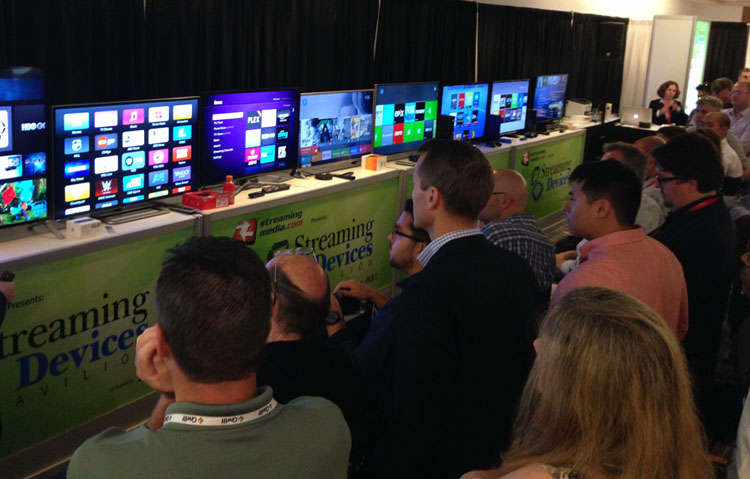
goodWe have a special streaming devices pavilion at the Streaming Media East show that allows thousands of attendees to get hands-on with more than 50 of today’s leading hardware devices and OTT platforms. You can test out any combination of gaming consoles, stand-alone streaming boxes, and smart TVs, with every streaming service in the market. It allows you to compare 4K and HDR side-by-side, learn how to cast content from small screens to TVs and gives you the opportunity to hear from many of these companies directly. No other show in the industry has anything like our demo area.

This year we “hope” to expand the pavilion to allow attendees to experience VR, and will try to showcase VR technology and content from some of the leading broadcasters and developers in the space. Much of this will be dependant on when HTC/Valve, Sony and Facebook make their hardware available in the market. If you are interested in getting involved in the VR demos, with content or with technology you want to showcase, please contact me. (917-523-4562) I’m looking to make the VR experience the best it can be for our attendees and show them what the future of this industry will look like.

Thursday Webinar: The State of Global Streaming Formats

Thursday at 2pm ET, I’ll be moderating a StreamingMedia.com webinar on the topic of “The State of Global Streaming Formats and its Implication for Publishers and Developers“. There is a lot said about what media formats are available, but not a lot of data on what is actually being used. With a global reach and thousands of publishers, Encoding.com has a unique view of the formats that are used to deliver media and entertainment content. This webinar will present their view on the state of the market for web, mobile and OTT distribution.

The webinar will also discuss how factors like native browser support, developer adoption and the desire for enhanced web media experiences drives the usage trends highlighted in this report and how these trends are accelerated by the cloud.

For anyone responsible for multiplatform, multiple device delivery, this is a must-attend event.

Register Now to attend this FREE live webinar.

Streaming Media East Program Now Live – Speaker Placement Starting

The advance program for the Streaming Media East show, taking place May 10-11 in NYC, is now live and speaker placement has started. You can see the full agenda here and read each session description and what it will cover. If you are interested in speaking on a session or placing a speaker on a session, please contact me. Here is a list of all the topics that will be covered this year (with a few more being added):

  • The Great Unbundling and the Mass Re-bundling
  • Encoding Live and On-Demand Video Using HEVC
  • Video Goes Virtual: Business Challenges and Opportunities Around VR Video
  • Building OTT Success: Improving Video Engagement
  • Live Social Broadcasting: Comparing Facebook Live, YouTube Live and Periscope
  • Evaluating SAAS, On-Prem, and Hybrid Deployment Models When Selecting an Enterprise Video Platform
  • Hands-On With Streaming Devices and OTT Platforms
  • H.265: Living Up to the Hype as the Successor to H.264
  • Improving Video Quality and Reducing Bandwidth
  • Streaming Deployment Architectures in Higher Education
  • Cracking the Multi-DRM Code: How Best to Build Secure Playback for Video
  • Adaptive Bitrate Algorithms: How They Work And How To Optimize Your Stack
  • Building A Streaming Solution Within The Firewall
  • The New Bundle: Moving Beyond Cable for the Digital Consumer
  • Hands-On Demo: Smart TV Platforms in Action
  • Building a Great Streaming Channel on the Roku Platform
  • How Live Streaming Is Changing Content Creation
  • DASH Today: Consortia Adoptions and Industry Deployments
  • Measuring the Effectiveness of Your Media Asset Management Deployment
  • Fine-Tuning Your Adaptive Encoding Groups With Objective Quality Metrics
  • How Big Stars and More Money Are Changing Short-Form Content
  • Advertiser Strategies for OTT
  • Driving Customer Awareness And Loyalty For Your Enterprise With Video
  • Business or Bubble? The Rise (and Potential Fall) of Subscription-based Monetization
  • A Brand New Deal: The Thriving Evolution of Sponsored Content
  • The Great OTT Migration

CBS Sports Having Problems With SuperBowl Stream, App & Website

Screen Shot 2016-02-07 at 6.34.09 PMCBS Sports is already having problems with the SuperBowl stream. I’m having a lot of issues loading cbssports.com website, frequently getting time out errors. When it does load, I get a video window that is black, with no stream. And on the Apple TV, the CBS Sports app won’t load at all. Appears to be a website and app issue as opposed to a stream issue. Akamai is doing the stream, with some other CDNs on standby in case CBS Sports needs to switch. More to come.

Updated: SuperBowl stream on iPad, using CBS Sports app has been perfect for me since kickoff.
