Archives

Video CDN Pricing Stable In Q4: Discounts Given For Lower Bandwidth Tiers

I've just completed my review of all the contracts and RFPs I saw in the market for the fourth quarter of 2008 and overall, pricing from the major content delivery networks for video delivery was pretty stable without much decline in pricing from the third quarter. (note: you can easily find my latest pricing post at www.cdnpricing.com)

Looking at pricing year over year, it looks like CDN pricing for video on a per GB delivered model fell between 30-35% from 2007 to 2008. While many of the contracts from the fourth quarter was for new business in the market and not contract renewals, those with renewing contracts saw on average about a 50% decline in pricing from a year or more ago. While that might make some think pricing fell in half year over year, remember that many of these contracts are 12 and 24 months in length and also included a lot more traffic over a twelve month period. Additionally, we saw many content owners increase their video bitrates from 300Kbps in 2007 to 500-750Kbps in 2008. In many cases this increased the number of bits they pushed by two or three times without any additional growth in traffic year over year.

The other trend from the fourth quarter is that many of the major CDNs are giving volume discounts on lower tiers. In the past, customers had to be doing hundreds of TBs per month to see major discounts, but in the fourth quarter, many CDNs were dropping the volume tier to lower levels. Those doing around 250TB a month are getting better volume pricing.

While many want to say that some CDN vendors are only competing on price or are giving the business away, this is not the case with the major providers. I have seen multiple instances where Limelight and Level 3 have passed on business because the customer wanted pricing that was too low. Yes, pricing is a factor but it is not the only factor for customers when signing contracts. For the quarter, the lowest pricing I saw in the market was still from newcomer BitGravity and the highest pricing was still from Akamai.

While some are speculating that Akamai is now starting to cut pricing for commoditized video delivery, I don't see that being the case across the board. In many cases they are offering lower pricing than before, but their bottom price that I saw was still about 20-25% more than what Limelight, Level 3 and CDNetworks are charging for completely commoditized video delivery business. You can read more on Akamai's recent pricing trends from my post last month entitled "Akamai Getting More Aggressive On CDN Pricing, But More Steps Are Needed."

For 2009, I don't expect to see a big decline in pricing. Even with the lower pricing that we are seeing from folks like Cogent and others, the CDNs all know that they can't give this stuff away. The content delivery business is all about the economics of scale. CDNs have to multiply the volume of traffic on their network many times over before the next round of major pricing discounts can take place. I think it will at least a year in the market before we see that happen. So while pricing always goes down based on customers doing more volume, I don't expect a big drop at all this year.

In my previous pricing posts, I was including pricing averages from roughly 15 different CDNs. I've quickly realized that this causes the average price to fluctuate greatly based on one provider being very high or very low in the market and skews the numbers. The pricing also changes drastically based on the volume of bandwidth that one is committing to, which I have also varied over previous post based on deals I'm seeing in the market.

Starting with this post, I am only going to use the pricing I see from the 4-5 major CDNs in the market to come up with the average price per GB delivered. Moving forward, I'm also going to keep the GB volume the same each quarter so that it is easier and more accurate to compare pricing from one quarter to another. This is not an exact science but keeping the data points consistent from one quarter to another will help everyone be able to better compare pricing over the course of the year.

For content owners, please keep in mind that the below pricing is not necessarily what you should pay. Many factors can and should affect the pricing and the averages I published are for large volume commoditized video delivery contracts.
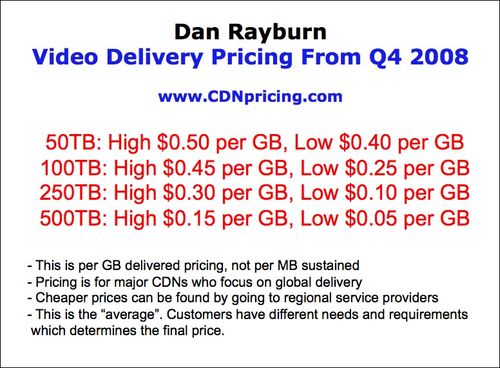
Q4CDN-Pricing

The average contract length I am seeing for video only delivery is
still 12 months. For contracts that include more than just video
delivery, things like small object delivery, static caching etc.
contract lengths average close to 24 months.


Sponsored by

New CDN Vendors Still Launching: Updated List Of Content Delivery Networks

Over the past few quarters, more content delivery networks have launched services in the market or have announced upcoming offerings. To try and keep track of all the different companies, twice a year I update my list of content delivery networks who offer some form of video delivery services. (To make the list easier to find on my blog, all you have to do is go to www.cdnlist.com for the latest update)

Every time I publish the list I get many comments from those who work at some of the CDNs saying it is not fair to compare vendors on this list with one another. For the record, this list is not comparing one vendor to another. It is simply a list of the vendors who in one shape or another offer some kind of video delivery offering. It would be like making a list of all the car manufacturers and the list would contain both Ford and Ferrari. But that does not mean you are comparing a Ford to a Ferrari. It's just a vendor list.

When it comes to the term "CDN", it is one of those terms that is very generic and can be debated all day long, similar to others terms in our industry like "cloud computing" or "edge network". Everyone seems to have different opinions on what it should mean. That being said, take a look at what companies analysts and the media write about in the market and see who they do and do not reference as a CDN. Some may not agree with them, but that's reality. The market defines who they think a CDN is.

To use this list to make comparisons of one provider over another without looking at a company's size, products offered, revenue generated, geographic reach of network, number of formats
supported etc.. would simply be inaccurate. Some of those companies listed are in beta with their offering and some literally have no customers as they have just launched in the market. Again, it is just a list of vendors, some of which are pure-play CDNs, others which aren't.

The companies listed are those who provide outsourced CDN hosting services. That's why companies like Konitki and others are not listed since they provide software to deliver video across your enterprise network. Same goes for companies like Swarmcast which is many times classified as a CDN when they are really a video platform. Additionally, companies like Ascent Media are not on the list as they provide video delivery service across a closed network from one customer location to another. For this post, I also did not list the video delivery providers who target a very specific geographic region which I classify as "regional service providers". At last count, there are over two hundred of these providers and you can find many of them listed in the StreamingMedia.com industry directory.

In alphabetical order these are the video delivery networks that I am currently tracking in the industry:

If you think a company is missing from this list, please feel free to add it in the comments section and please make sure you read all of my post before making any comments.

Verizon Cuts Peering Costs To CDNs: The Real Story Is More Than Price

Verizon-logo
Yesterday, Verizon announced a new program dubbed the "Verizon Partner Port Program" which gives content owners and CDNs the benefit of a direct connection from their content storage devices to the Verizon Internet backbone network. While Verizon is saying that they are offering "a significantly lower price to connect directly to the Verizon Internet backbone network," this is about more than just lower pricing.

Some would argue that Verizon is simply offering lower IP transit prices, which really is not that big of a deal. Agreed, from a high-level, that's all this could look like. But after speaking with two major CDNs yesterday, they are very interested in this Verizon offering and say that it may enable them to offer a lower price to any content owner who wants to reach Verizon customers.

While many of the major CDNs already connect to Verizon via peering connections and NAPs, this new service offers CDNs a lot cheaper transport costs than just a traditional IP transit link they would negotiate with Verizon. Since these new connections would be all outbound traffic and not inbound, Verizon can manage their network differently and offer a lower price. CDNs have the ability to connect to Verizon from ten data centers in the U.S., most of which are Equinix facilities.

While Verizon would not disclose pricing to me, CDNs that had already spoken to Verizon talked pricing with me that was much lower than what they would pay for traditional transit services. And one of the CDNs I spoke to said that if Verizon could offer pricing that much lower, the CDN could in turn offer content owners a cheaper price to deliver their content to Verizon subscribers. If that in fact happens, this Verizon offering becomes more than just about lower IP costs. It means it has the ability to reduce the content owners distribution costs, the CDNs operating costs and provides a better experience for users like me who are on the FiOS network.

P2P Provider Octoshape Hires Scott Brown As New CEO For U.S.

Octoshape
Scott Brown, formerly from Turner Broadcasting has been named the new CEO in the U.S. for P2P provider Octoshape. Earlier this week, Turner and Octoshape announced that Octoshape's P2P technology was used by Turner for live stream offerings for both the 2008 elections (CNN) and their live sports coverage from TBS.

The P2P solution is running on the Highwinds content delivery network and while the release says that "Octoshape broke several streaming records", no actual numbers were disclosed. The real test is going to be in the next few weeks when CNN will use the technology during the presidential inauguration.

GM of Microsoft’s Edge Computing Network To Keynote Content Delivery Summit

Jeff-msft
I'm happy to announce that Jeffrey Cohen, GM of Microsoft's Edge Computing Network is our first confirmed keynote for the Content Delivery Summit taking place in May 2009. Jeffrey brings some very unique experience to the summit since he is responsible for the build out of Microsoft's own internal content delivery network but also contracts directly with all of the major CDNs on video delivery.

As many have probably read, there has been a lot of speculation going on in the news recently about Microsoft's CDN plans and what they could mean to the industry. Some have suggested that Microsoft plans to compete with other CDNs, might potentially purchase a CDN or could take all of their own CDN business in-house. This is your chance to come hear first-hand what Microsoft's CDN strategy is and hear their thoughts on the role that online video is going to play in the future.

Level 3 and Limelight Should Settle Patent Suit, Here’s How

On Monday, in the Eastern District Court of Virginia, the Level 3 and Limelight Networks patent suit got underway. While this is only the start of what is expected to be a long and drawn out legal proceeding, I think Level 3 and Limelight Networks should come to terms and end the suit.

As a company, Level 3 is in a very different position today than they were almost two years ago when they first notified Limelight about the patents they control from the SAVVIS acquisition. Two years ago, Level 3's stock price was around $7 and they had a market cap of almost $10 billion. Today, their stock is under a dollar and their market cap is under $2 billion. Times have changed, the economy has gotten worse and companies are now doing everything they can to cut costs. 

Like all companies, Level 3 is under a lot of pressure in the New Year to increase sales, but they also have a lot of debt to worry about. The telecom industry could take a big hit in 2009 and one would have to think that Level 3 will raise more money as soon as market conditions allow. In my opinion, the last thing Level 3 needs right now is to be spending money, time and resources on a patent suit with Limelight. Even if Level 3 were to win the suit, the process would most likely take years with all the appeals and it's not as if Level 3 would get a lot in the way of damages when compared to the rest of Level 3's total yearly revenue.

Meanwhile, Level 3 spends millions on the suit, ties up executives and can't spend every waking second possible working to improve the rest of their business. Any company engaged in a lawsuit is always distracted in some way from focusing 100% on their customers. Not that the suit helps Limelight Networks either, which is now spending money and time on two suits, the other being from Akamai. The difference however with the Akamai suit is that Akamai and Limelight are a lot more similar in terms of services offered than Limelight and Level 3 are. Level 3 is a carrier and as a result, gets the majority of their revenue from other services outside of similar CDN services offered by Limelight. Level 3 has a lot less to lose with Limelight than Akamai does.

In addition to Level 3 and market conditions changing in the past two years, the technology being debated has changed quite a bit since that time as well. Much of the Level 3 suit is talking about very generic technology and in my opinion, language that could be debated forever. My impression is that when Level 3 filed the suit, it was based on their assumption and interpretation of how they thought the Limelight Network was operating at the time. But compared to two years ago, Limelight is an entirely different company from a technology and services standpoint. Much has changed and I wonder just how much of the patents in question are even relevant to Limelight's offering today.

Like any company, Level 3 wants to protect their patent portfolio and enforce what they believe to be infringement on Limelight's part. But at the same time, I think Level 3 has to weigh what can be gained in the long run, by what can be lost in the short term. Unless a settlement is reached, Level 3 is not going to see any money anytime soon, and could lost the case and never see any money at all. Meanwhile they spend their own money and time on the suit and can't spend that time on improving their business in other ways. It's a bad time for Level 3 to be doing anything other than focusing 100% on their business.

So how could Level 3 and Limelight settle the suit? Limelight buys a lot of transit, one of the core services offered by Level 3. Level 3 could come to some kind of agreement to drop the suit against Limelight if Limelight purchased a certain amount of transit from them each year. I don't know what percentage of transit purchased by Limelight is from Level 3, but I'm sure it is a number that could be greatly increased. Level 3 would get immediate revenue, would cut the millions they are going to spend this year on the suit and could focus their efforts on other aspects of their business. And with Level 3 offering other services Limelight purchases, like co-location, one could make a reasonable argument that Level 3 could sell Limelight other products outside of just transit. I don't think it's that far fetched of an idea.

While I have no knowledge if any such discussion is taking place amongst Level 3 and Limelight, we are at a point in business where all companies are looking at ways to cut costs, increase revenue and focus their efforts on strengthening their core business, not spending time on things that are distractions. Level 3 could accomplish all of these things by thinking about other ways to solve the patent disagreement outside of being engaged in a multi-year, multimillion dollar suit.

Related Posts:

Judge Denies Limelight's Motion For Summary Judgment In Level 3 Case

Details From The Markman Ruling In Level 3 and Limelight Networks Patent Case

Apple Drops DRM From iTunes Music, But What We Need Are DRM Free Videos

Today, Apple announced at Macworld that by the end of the first quarter, all songs in their catalog will be DRM free. While that's nice, but not really that big of a deal, the real question is when DRM free videos will be made available?

Lets face it, most folks who buy music from iTunes only want to play it on an iPod anyway and are not moving the content around to many other devices. Music is not what's driving the growth of the Internet, new applications, or bandwidth consumption. It's all about video. If Apple really wants to push the market forward and help video consumption explode, it needs to convince content owners that offering DRM free videos would help jumpstart the industry. New business models would be created overnight and consumers would be happy, which means they would buy and consume more content. We'd see an amazing amount of growth in just a year's time.

For all we know, Apple is already doing this and trying to convince content owners of the need for DRM free videos. But until the day consumers can buy content once and move it to any device they want, the market for purchasing video content won't see the kind of growth that many of us in the industry have been waiting for.