
A Year Later: Examining Google Media CDN’s Evolution in Scale, Monitoring, and Architecture
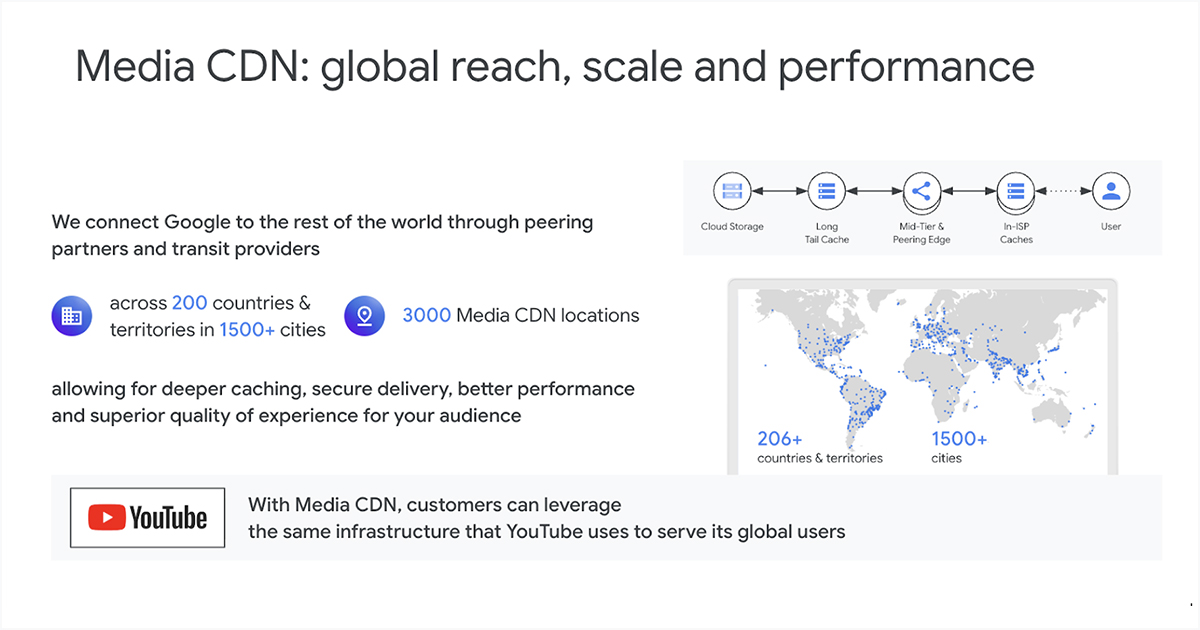
A year ago, I wrote about Google’s Media CDN offering and its positioning in the market, which was primarily centered on leveraging Google’s network for large-scale video delivery. As with any service, the initial value proposition is only part of the story. The more telling measure is its subsequent evolution in response to customer usage and industry demands. A year later, Google has made key enhancements to its Media CDN, focusing on adding capacity and operational tooling, as well as onboarding large media and entertainment customers.
The fundamental challenge for CDNs remains handling massive, concurrent traffic spikes associated with live streaming. Events over the past year, such as the Super Bowl, FIFA World Cup, and IPL, have continued to set new streaming benchmarks. One notable change in Google’s Media CDN offering is that since early 2025, it has tripled its delivery capacity through a combination of Google’s Media CDN offering and YouTube capacity. Beyond raw capacity, several architectural and commercial updates have been introduced to address common customer pain points around origin performance and budget predictability.
Google has added new caching and routing options, including Flexible Shielding, with shield regions in South Africa, the Middle East, and the U.S. The goal is to improve cache offload rates by keeping traffic within a region, thereby avoiding the latency and data-transit costs associated with the “hairpinning” effect of fetching content from a distant origin. This is an add-on feature that lets customers choose between optimizing for performance or offloading, in addition to the platform’s existing multi-region caching and shielding architecture, which is offered at no cost.
Google says a series of updates is aimed at solving common origin integration issues. For instance, the platform now supports HEAD requests, has increased its maximum segment size from 10MiB to 25MiB (likely to better support high-bitrate 4K streams), and has added support for multi-part range requests. These changes suggest a focus on improving interoperability with a wider range of customer storage configurations. On the commercial side, Google has introduced monthly savings plans. This model provides a committed-use discount, giving customers a more predictable TCO, a departure from a pure pay-as-you-go cost structure.
For live events, real-time performance visibility is critical. Google has introduced a Monitoring as a Service (MaaS) offering, positioned as a “broadcast operating center” equivalent. It is designed to provide a customer’s operations team with intensive, proactive support for events, with a consolidated view of an event’s health, from origin performance to end-user metrics.
The tool’s intended impact is to enable proactive issue detection, allowing teams to identify potential problems before they affect a large number of viewers. For customers with large-scale events that have used it, the tool is intended to provide real-time data needed to manage a professional broadcast.
Google’s initial market entry with its Media CDN offering was focused on its network foundation. The changes over the last year, however, indicate a shift toward addressing more specific, operational, and architectural challenges faced by large-scale broadcasters. The introduction of more flexible caching, origin compatibility fixes, and broadcast-grade monitoring tools suggests a maturing platform. The true measure will be how these enhancements perform under pressure across a broader range of customer workloads, but the direction of development is clear.