
Netflix Says AV1 Codec Now Powers 30% of Netflix VOD Streaming
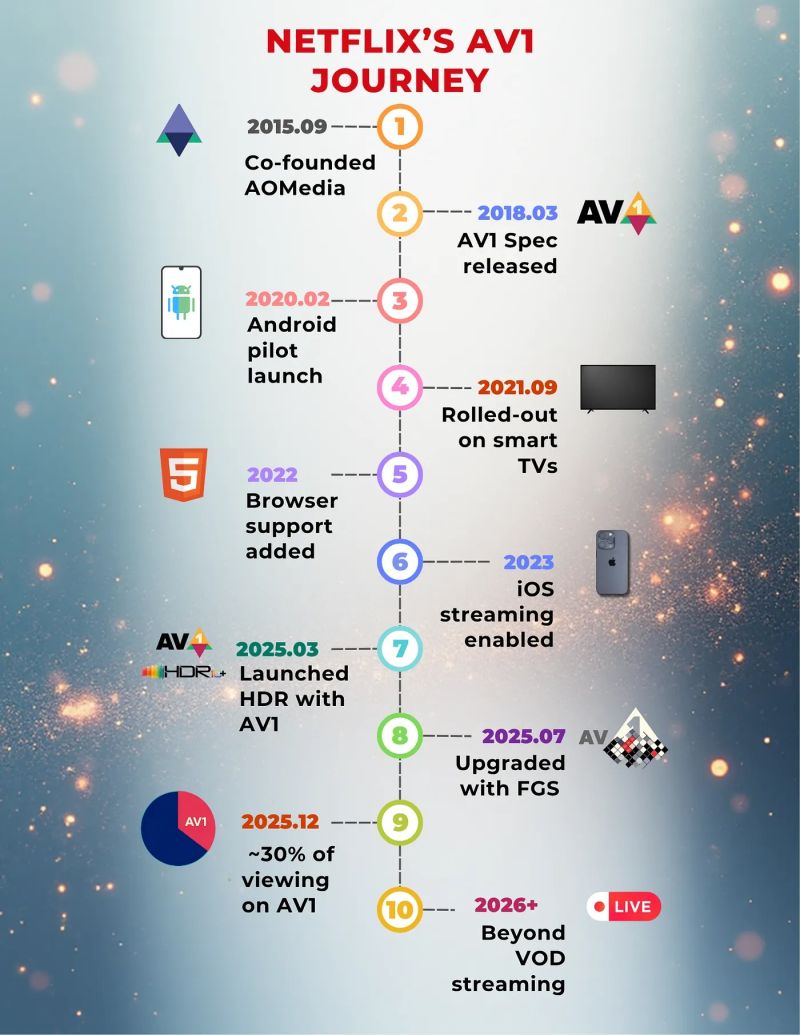
Netflix’s latest tech blog details how AV1 now powers approximately 30% of all Netflix viewing (on demand), following the launch of AV1 support on Android in 2020. While H.264/AVC remains the primary codec for Netflix viewing, the company expects AV1 to become the top codec very soon. Some other key takeaways from Netflix’s post:
- AV1 sessions use one-third less bandwidth than both AVC and HEVC, resulting in 45% fewer buffering interruptions
- On average, AV1 streaming sessions achieve VMAF scores that are 4.3 points higher than AVC and 0.9 points higher than HEVC sessions
- 85% of Netflix’s HDR catalog (from the perspective of view-hours) has AV1-HDR10+ coverage, and this number is expected to reach 100% in the next couple of months
- The AV1 specification incorporates a unique solution called Film Grain Synthesis (FGS), allowing Netflix to deliver a realistic cinematic film grain experience without the usual data costs
- Netflix is evaluating the use of AV1 in live streaming to deliver high-quality live experiences to large audiences without compromising video quality, and to reduce its delivery costs
- AV1 offers an opportunity to make graphic overlays highly customizable, since layered coding is supported in AV1’s main profile
- Over the past five years (2021–2025), 88% of large-screen devices, including TVs, set-top boxes, and streaming sticks, submitted for Netflix certification have supported AV1, with the vast majority offering full 4K@60fps capability
Netflix says it is excited about the forthcoming release of AV2, announced by the Alliance for Open Media in September, with an expected release at the end of this year.