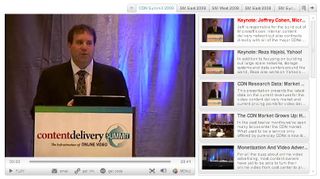
Videos From Content Delivery Summit And SM East Show Now Online

Video-player All of the sessions from the Content Delivery Summit have now been archived and are available online at www.streamingmedia.com/videos – In addition, all presentations from the sessions can be downloaded separately at www.streamingmedia.com/east

Most of the Streaming Media East videos are there are well but we still have a few more to add over the weekend. All of the videos have the ability for anyone to embed the clips directly into their website or blog if you like. I'll be highlighting some of the videos on the blog over the next few weeks.

Our thanks to Quality Tech's media services division who captured, edited and encoded all of the videos and to Brightcove for making their video platform available to StreamingMedia.com

Sponsored by

Breakdown On How Many Streaming Entertainment Devices Sold To Date

I have a post over on GigaOM.com today that breaks down the number of Xbox 360, TiVo, Roku, VUDU, Apple TV, and Broadband-enabled TVs and Blu-ray Players sold to date. I also reference some numbers on how much content is being consumed on the Xbox 360 and across offerings such as Netflix. You can read the article here.

Moderating Webinar At 2pm ET: Topic, Live Streaming

Today at 2pm ET I’ll be moderating another StreamingMedia.com webinar on the topic of live streaming. We have Microsoft, Digital Rapids, Thomson Reuters and StreamTheWorld all presenting and we’ll be doing an extensive Q&A session after their presentations. The subject of live streaming is a topic that always garners a lot of interest and questions and we have almost 900 people registered to attend. You can register to attend this free webinar here.

We’re also giving away a TOMTOM GPS system to one lucky attendee.

Webinar 2PM ET Today: Cut Costs by Getting the Most Out Of Your CDN Ecosystem

Join me today for a free StreamingMedia.com webinar starting at 2pm ET entitled “How to Cut Costs by Getting the Most Out of the CDN Ecosystem“. Content delivery provider Internap will be outlining the different pieces of the video ecosystem, how to decide when to outsource the different pieces and we’ll be taking questions from the audience on any aspect of content ingestion, storage, transcoding, managing, delivering, tracking and other related ecosystem pieces.

The event is free and you can sign up here. All attendees are registered to win a TOMTOM GPS Car Navigation System.

Why Can’t The Industry Agree Upon Pre-Roll Ad Lengths? 41 Second Ads?

Is there anything about the online video industry or it's practices that anyone agrees upon? No one agrees on the size of the market or what the growth is, content owners can't agree on which type of ad formats are the most valuable or what length ads should shown for short or long form content. While watching a two and a half minute clip on NBCSports this morning, I was delivered a 41 second pre-roll ad. (Updated: NBCSports.com shares the same ad system as MSNBC.com, so the ad I saw was actually coming from MSNBC.com) How did they come up with 41 seconds as the ideal time? And why did another clip that was the same in length, then give me a 30 second ad? Why is there absolutely no consistency in this market?

The online video industry should be a lot further along then it is right now. I know when I say that many from the industry say I should focus on the positive, but seriously, the consumer experience for online video advertising right now is horrible. Nearly all ads are not targeted, content owners are not making money, content owners are cutting up content into too many pieces, and while I said two years ago that "15 Second Pre-Roll Video Ads Will Become The Standard", clearly that was wishful thinking on my part. In the last week I've gotten ads that range from 10 seconds, 15 seconds, 30 seconds, 41 seconds and 60 seconds. What is going on? How do content owners not realize the affect this has on the consumer experience?

As a consumer, I am so frustrated with the online video ad experience.

Limelight Moving Up The Stack, Acquires Kiptronic For Mobile Ad Delivery

Images This morning Limelight Networks announced it has acquired privately held Kiptronic to further Limelight's expansion into the mobile video space. Over the past year, Limelight has been building out their mobile video offering, currently being used by MLB amongst others, and with the Kiptronic acquisition, Limelight is looking to combine their mobile delivery with Kiptronic's platform for delivering ads to mobile devices. Updated: While neither company will discuss the terms of the deal, I've learned that Limelight valued Kiptronic at around $12M. Updated 8/6: On Limelight's Q2 earnings call, the company said they paid $1M for Kiptronic. Looks like the finance person I spoke to had no clue what Limelight truly valued the company at.

Over the next twelve months I expect we'll see more acquisitions like this since Limelight's goal is to move up the video ecosystem stack and do more than just delivery. All of the CDNs are talking about "value add services" these days and are trying to diversify their revenue stream and do more than just deliver bits. For small companies that provide valuable pieces in the ecosystem, many of them are going to be natural acquisition targets for some of the larger CDNs.

Kiptronic was a small company of 15 developers so with Limelight now providing them with scale and resources, Kiptronic can do a better job of showing value to the largest content publishers. Kiptronic counts customers such as NPR, FOX, The Guardian, Conde Nast,
The Economist, and NBC.com as customers and Limelight has to also be
hoping that the acquisition gives them access to these customers to convert them over to Limelight's network for mobile video delivery.

I expect that over other next few months, other CDNs are now going to feel pressured to put out a story on how they too support mobile video or what their mobile video strategy is, even though the vast majority of them don't have one, which I think is ok. While this is a smart, strategic long-term move for Limelight, it's very, very early in the
mobile video space and the market is not that big in the U.S. from a revenue perspective.

One interesting thing to note is that Limelight has confirmed that Kiptronic will continue to work with publishers that use other CDNs that are not Limelight.

The Economy Of The Video Ecosystem: Finding Ways To Reduce Costs

2009-SM-Think-Series-1 In today’s economic climate, everyone is being asked to do more with less. Online video publishers are no exception, and they face the dual challenge of having to increase their traffic while at the same time reducing their costs. Rather than pulling back on the amount of video that they publish, content owners need to continue to publish as much as possible and do everything in their power to generate revenue faster.

Of course, content owners have to pay for the encoding, hosting, and delivery of every piece of content that goes online, on top of video creation and acquisition costs. And while traditional broadcasters incur no additional cost for each viewer, online video doesn’t scale in the same manner. Adding more videos and more viewers for online content only increases your costs and, in some cases, that cost means the difference between content owners publishing their entire catalogs versus only a portion. While these fundamental challenges have always existed for publishers, recent budget cuts make cost savings more crucial than ever. Publishers need to look at the entire video ecosystem and find ways to reduce their costs while they increase both the quantity of content and the overall quality of the online viewing experience.

Since the vast majority of content owners use a third-party content delivery network (CDN) to deliver their videos, most publishers are well aware that they can quickly reduce their costs by simply cutting their bandwidth bill. While that may work for content owners that previously signed long-term contracts at a higher rate or for a publisher whose contract is about to expire—and who can therefore shop around for a lower price—many content owners are already locked into a contract. Contract issues aside, most publishers can’t simply cut their bandwidth bills since they push more bits when they increase their traffic and deliver more bits when they encode their content at higher quality.

Content owners that know their traffic spikes can make the decision to commit to less traffic per month, use a second CDN for overflow traffic to avoid overages, or commit to bandwidth on a quarterly or yearly basis instead of a monthly one. But for the vast majority of content owners whose online video business is new or for publishers that have varying and unpredictable levels of traffic, it’s not that easy to save money on the delivery of video. That’s not to say that publishers can’t get the best of both worlds—cutting costs while still growing traffic—from a CDN. To do so, content owners have to look beyond bandwidth and consider other services CDNs provide that can reduce their costs while they increase both the quantity of content and the overall quality of the online viewing experience.

Since the vast majority of content owners use a third-party content delivery bandwidth bills since they push more bits when they increase their traffic and deliver more bits when they encode their content at higher quality. Content owners that know their traffic spikes can make the decision to commit to less traffic per month, use a second CDN for overflow traffic to avoid overages, or commit to bandwidth on a quarterly or yearly basis instead of a reduce overall video costs. While all content owners should look at ways they might be able to save on bandwidth, they really need to examine where they are spending money on the entire video ecosystem, from content creation to delivery and everything in between. For many content owners, CDNs can help reduce overall video costs by doing more than just offering a lower price per gigabyte delivered or megabyte sustained. And they can do it without publishers having to sacrifice the volume of content they put online or the quality of the video they’re making available.

You can read the rest of this article from StreamingMedia.com's Think Series, sponsored by Internap, for free here.