Google Chrome To Keynote Streaming Media East Show: Discuss HTML5 And Video Ecosystem Challenges

Jeremy-with-logoI'm pleased to announce that Jeremy Doig, Director of Engineering for Google Chrome will kick off the Streaming Media East show on May 15th with a keynote discussing how device, operating system, and browser differences impact the video ecosystem.

With HTML5 bringing native media support to web browsers, a whole a new set of opportunities and technical challenges have been created for content owners and distributors of online video. Enabling the best possible experience across the broadest set of devices and platforms raises some hard questions around compatibility and evaluation of what the core requirements for online media technology are. Jeremy will discuss how device, operating system, and browser differences impact the video ecosystem and what content owners can do to help ensure a consistent user experience. Attendees will also hear about Google's direction for online media technology and get their questions answered in a Q&A session after the keynote.

We'll also be giving out some Google Chromebook's after the keynote and as always, all keynotes are free to attend. Simply go online and register for an exhibits pass and you're in. You can also register for a full conference pass at the discounted rate of $545 using my personal promo code of DRF01.

Don't Miss this at Streaming Media East!

How-to Sessions
Get ready for more hands-on sessions than ever before! Join some of the industry’s leading instructors in 18 “how-to” sessions on the various technical aspects of the industry – encoding, videoplayers, webcasting productions, and more. See them in the program.

Device Pavilion
Your chance to get hands-on with some of the hottest devices available this year! Find out more.

Sponsored by

2012 CDN Pricing Survey – Answer 10 Questions, Get Access To The Results

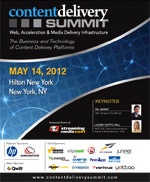
I have started doing my annual collection of industry pricing data (www.cdnpricing.com) from customers who used third party content delivery networks for the delivery of video. The survey consists of 10 questions and anyone who answers the questions will get a free copy of the entire results. All respondents will also be entered into a drawing to win a Kindle Fire and I will be presenting all of the results of the survey at the Content Delivery Summit, May 14th in NYC. You can register online for the event using my personal promo code of DRF01 and get a ticket for only $295.

Survey_button

Report: Walmart To Charge $2-$4 Per DVD To Convert Movies To UltraViolet Cloud

[Updated: Tuesday, March 13th – Walmart announced they will charge $2 for SD and $5 for HD.]

Tomorrow at 1pm ET, Walmart along with UltraViolet partners Universal, Paramount, Warner Brothers, Sony Pictures and Fox will announce Walmart's UltraViolet offering. Studio execs I have spoken with say that consumers will be able to bring their DVDs into Walmart, which will then charge the consumer between $2-$4 per DVD to give the consumer access to that movie in the UltraViolet cloud locker system. DVDs will then be stamped at the store, so they can't be used by multiple people and I'm told pricing for converting the DVD to digital will vary based on either SD or HD quality.

I'm sure the studios and Walmart are going to talk about how great this is for consumers and they will probably use a term like "nominal" to describe the fee consumers will have to pay. In reality though, the studios are doing exactly what consumers don't want, which is forcing them to pay multiple times for the same piece of content. The fact that consumers already spent money to buy the DVD apparently is not good enough to allow them access to a free digital copy, which they could easily get if they ripped the DVD on their own. It costs the studios almost nothing to store the movie in the cloud, about two cents per movie, and it only costs about four cents, at most, for them to pay a CDN to stream the movie to the user. So at $2 per DVD, a user would have to watch the movie 50 times from the cloud before the studio was losing money from digital.

Consumers have been vocal in saying they want more content digitally, at a fair price, and many of the studios are acting like they are giving consumers what they want, when in reality, they aren't. You can get digital, but only of you pay for the movie again. And you can get a digital copy with the Blu-ray disc, but only if you pay between $5-$10 more for a copy that includes a digital copy. Pricing seems to be all over the map for a Blu-ray with digital copy, but they are clearly much more expensive than just the Blu-ray only disc.

While there have been a lot of technical issues with the UltraViolet system that have been well documented in the media, those issues could be resolved over time, but it's no guarantee. UltraViolet is not easy to use, it requires multiple accounts with multiple websites, there is very little device support and Disney and Apple refuse to join the consortium. Physical Blu-ray copies with digital are more expensive and studios are charging so much for their download and own offerings, between $15-$25 a movie, that it makes more sense for a consumer to rent the movie for $3.99 instead of buying. Many studios have gotten so greedy that they are pricing themselves out of the digital download to own market. In addition, with the way the content windowing works for content going from theatre, PPV, rental, purchase etc. the studios are now going to have to augment that window in some way to allow for the new UltraViolet offering.

Aside for all of this, UltraViolet is a cloud based system that requires you to have to be connected to the Internet. As far as I know of, there is no way to play your movies from the cloud locally on your machine if you don't have access to the Internet. You have to connect to UltraViolet's system to get you license key and if you can't you won't be able to play any content. Unless UltraViolet comes up with an option for local playback, your entire library of movies and content will be in the cloud not accessible locally. That's not going to be ideal for a lot of people and it also requires consumer to once again choose between one quality over another. Studios should want to deliver consumers the best quality video available, yet they are going to force many users away from HD, simply due to price. That's not the best user experience.

Another topic one has to wonder about is privacy. UltraViolet is going to know every movie you stream from the cloud. And with so many studios, broadcasters, CE manufactures etc. in the program, what you what and when you watch it is going to be known. Who has access to that information? I can't find any language on the UltraViolet website that talks to the privacy of one's account in the cloud. Are they going to be data mining our usage habits and sharing that with third party companies? If they do, and I expect they will, that data is worth a lot of money to advertisers who will then know the demographics of who is watching their movies. That is very powerful data that UltraViolet is collecting, which they can make a ton of money from.

And what if UltraViolet starts using that information to track what you do outside of UltraViolet? Can they now deny you access to a movie in the cloud if they notice your IP address shows up in a torrent site? Can they now disable your UltraViolet account? In the end, do you really own the content that is in the cloud? I think this could be a major concern if the service starts to get some traction and is something UltraViolet will need to address

In January, Paramount rolled out a service to sell ten year old movies via the UltraViolet cloud for $22.99 for HD. Many of these same movies are available via Blu-ray for $8-$10 cheaper and I still can't find any definition from UltraViolet on what they classify as an "HD" movie. What exactly is the quality? How was it encoded? Is the digital copy in the cloud comparable to the Blu-ray disc? I highly doubt it as it would probably require 8-10Mbps to stream, which means the studios are selling HD digital copies, which are less quality than the Blu-ray, yet are charging consumers more for it. And the studios think this is something consumers won't notice?

Every year the studios seem to come up with new ideas and ways to try and charge consumers for movies. First it was the studios delivering two-hour movies to cell phones, even though consumers weren't and still aren't asking for the service. Then came the studios charging more for a digital download over the physical DVD. That was quickly followed by Sony charging $24.95 for a 24-hour rental and admitting it does not want to upset Walmart and the studios own DVD business. Then you had studios charging consumers more for movies on USB drives, and you also have some of the studios forcing Netflix and Redbox (and library's) from renting physical DVDs for 28 or 56 days, because the studios are trying to force consumers to buy more DVDs. Not to mention you constantly have the MPAA complaining about piracy. I don't condone stealing, but what do the studios think will happen when they aren't giving customers what they want at a fair price and will do everything in their power to prevent consumers from copying their own DVDs?

As a whole, the studios still don't get it. They aren't listening to consumers, they haven't truly changed their way of thinking and their pricing and business models don't make sense. In reality, a back-end system like UltraViolet that would allow such seamless viewing across all devices still hasn’t been created and it won't be the studios that make it happen.

Multiple Cable Operators Say They Are Not In Talks With Netflix To Bundle Services

Earlier in the week, Reuters was reporting that Netflix's CEO was in talks with cable operators about bundling Netflix's streaming service in with cable TV packages. Of course when then media got wind of the story, most of them naturally assumed something was in the works, yet a quick check with execs at many of the MSOs tells a very different story. Over the past week, I spoke to four different cable TV execs, three in the U.S. and one in Latin America, who all say no such deal is in the works. Add in the recent public comment from Comcast and that's five major MSOs who say the Reuter's story is "all noise".

Meetings between Netflix and the MSOs take place all the time and one cable TV exec told me that, "bundling was definitely on the table but discussions never went very far." Another said that, "in our many meetings with Netflix, the bundling of services is something that always comes up, but it is not something we are actively looking at". Cable TV executives has told me that the idea of bundling Netflix's service with their own is not new and that it has come up in their various discussions with Netflix, "over the past two years". The Reuters story made it sound like the idea of bundling was something new and called their story an "exclusive", but it's clear there is nothing new about the discussions at all. Each of the MSOs I spoke with reiterated that they have a clear strategy for video OTT and IPTV and are not currently working on any such bundling deals with Netflix.

Some suggested it would make more sense for Netflix to bundle their services with MSOs outside the U.S. in countries where credit cards aren't popular. That would give Netflix a way to charge for their services, through the MSO, who already has the relationship with the consumer. But a quick check with some of the major MSOs in these regions reveals no such deal is in the works. In a NYT story, which did a good job of questioning the news, they quoted Netflix as saying that Netflix's CEO comments about bundling were "futuristic."

Aside from the obvious content licensing questions around a bundled Netflix service through an MSO, cable execs also told me that they don't think that Netflix currently charges enough for their service to be able to share with the MSO the kind of revenue split they would want. One cable TV exec said, "at $7.99 a month, Netflix does not have a lot of revenue to share with any cable operator. Netflix would need to charge more per month to be able to give MSO's a few bucks per user". Those I spoke with all suggested that Netflix would also have to acquire a lot more original and exclusive content in order for such a service to even make sense.

Adding all of these details up, it appears that Netflix's desire to bundle their service with cable TV operators is just a wish for now, with nothing in the near-term taking place.

Apple Updates $99 Apple TV, But With No Subscription Service, It’s No Game Changer

Screen shot 2012-03-07 at 2.37.35 PMAt Apple's iPad event, the company announced an updated version of their Apple TV streaming box, which now supports 1080p video and has a new user interface (pictured at left). Pricing on the Apple TV remains at $99 and can be ordered today, with devices available in stores next week. Also related to the Apple TV is the announcement that iCloud now supports streaming for movies. Users will now be able to re-download movies they have purchased on any iDevice and stream it via the Apple TV.

While it's nice to see Apple offer 1080p support on their device, to date, they have sold less than 5M second generation Apple TV units in the past 18 months. Without some kind of content subscription service, this updated Apple TV isn't going to disrupt the market at all. It's a great box for doing AirPlay mirroring but it still lacks the ability to run apps and simply updating it to support 1080p is pretty weak. Nearly all of Apple's competitors in the $99 streaming box space have been supporting 1080p video for years and have support for side-loaded content via USB. Not to mention, the Apple TV does not support Hulu Plus, Amazon, have a web browser or an open SDK for developers. It's really only a device targeting iPad/iPhone users for AirPlay functionality. If Apple brought more third-party content to the box that would help, but they didn't mention any new content partners during their presentation, so don't get your hopes up. To me, Vizio's new $99 streaming box will kick Apple TV's butt, in terms of functionality and value.

Apple is so short-sighted on their living room strategy because if they Licensed iTunes For Non-Apple Devices, They Could Own The Living Room. But we know that's not going to happen.

Updated 1:55pm: I have confirmed that users of the older 720p Apple TV will not able able to get 1080p support via a software update. You want 1080p, you'll have to spend another $99 and buy the new Apple TV. Typical Apple. Add a new feature that has been out for years, and charge people more for it in a "updated" version. There is no excuse for Apple not having 1080p support built in to the second generation model to begin with. Users of the 720p Apple TV model will be able to get the new user interface.

Updated 3:00pm: Netflix has just announced that consumers can now sign up directly on their $99 Apple TV and pay for a Netflix subscription via their iTunes account.

Frost & Sullivan Webinar Today – CDNs: Latest Trends, Product Offerings & Market Data

Updated: The event has now been archived here. Today at 3pm ET I will be presenting a Frost & Sullivan webinar on the topic of Content Delivery Networks, highlighting the latest trends, product offerings and market data. As a principal analyst in Frost & Sullivan's digital media group, three to four times a year I present free webinars and take questions on different topics in the digital media landscape.

The service-based content delivery market has seen a lot of consolidation in the past few quarters, as well as growth in the volume of data being delivered by content owners. At the same time, carriers and operators are deploying more CDN-related technology inside their network as they look to take more control of the last mile.

Topics to be covered include:

  • dynamic site acceleration and front-end optimization solutions, and the role they play in the CDN market
  • the latest CDN federation models and standards
  • where the CDN market is headed and how the CDN ecosystem is changing
  • the size of the CDN and transparent caching markets

I'll also be doing a live Q&A with attendees so sign up here and bring your questions. This webinar is free to everyone and you don't have to be a customer of Frost & Sullivan's research in order to attend. 

Cable TV Isn’t Dead or Dying, Yet The Media Is Obsessed In Saying It Is

If you have read my blog long enough you probably know by now that I absolutely hate it when the media sets wrong expectations in the industry. First it was their notion that ISP caps would kill the online video industry, yet that didn't happen. Then it was the promise of TV everywhere being some kind of new monetization platform, yet so far, almost no TV everywhere services even exist. Next up was the idea that cord cutting was a big trend about to disrupt the cable TV providers, but as we have seen, that's had no impact on the market and MSO's are still making a lot of money and not losing a lot of subscribers. Yet even with all of these hard facts and figures in the market, it still does not stop a large portion of the media from writing post after post about how the cable industry is getting their butt kicked. In reality, most of these blogs are simply picking headlines that sound good, but offer nothing in the way of evidence to back it up and many of the authors of these posts are completely out of touch with reality.

The latest article on the "cable is dead or dying" topic appears on Venture Beat entitled "How Roku is kicking the cable industry’s butt & where it’s going next [exclusive]". The first problem with the article is that there is nothing "exclusive" about it. The information Roku's CEO gave out and what he's quoted as saying in the article is the same info he has given out to many members of the media. There is nothing "exclusive" about what is reported or what is said, yet many bloggers seem to put the word "exclusive" in their post simply as bait. I think many bloggers spend more time crafting the title to their post than the actual post itself (Updated: Here's another article that just came out in the last hour entitled "TV Everywhere: How the Internet is Killing Cable". Useless drivel)

No where in the article does the author compare the numbers of cable TV subscribers to Roku's install base. While it says that Roku has sold 2.5M boxes to date (note that's boxes, not unique users) and "expects to sell 19 million boxes over the next three to four years", those numbers mean nothing unless you compare it to the cable TV install base, which is over 100M in North America today. And while it's nice to see it reported that Roku did $100M in revenue for last year, that pales in comparison to just one MSO like Comcast who generates more than $1B in profit each quarter. While I personally like Roku and think it's the best $99 box on the market, it's not kicking cables butt. In fact, Roku's CEO even says that Roku is a compliment to cable TV, not a replacement, yet the author of the post still tries to imply that Roku is replacing cable TV.

When Apple came out with the first Apple TV model, the media said it would kill off DVDs. That's didn't happen so when Apple came out with Apple TV 2, the media then said it would be different this time as this model was only $99. To date, Apple has sold less than 5M devices and it has not had any impact on the overall advancement of the market or disrupted any competitors. Yet, now the media wants to talk about how an all-in-one Apple TV will "disrupt" the market, because they want to imply that the current way of doing things is outdated or dead. Cable TV is not dying.

While this latest Venture Beat article is the one I am using as an example of my point, there are many like it. Each week I read members of the media saying things like, "cord cutting is now a reality", "cable companies are antiquated", or they imply that any service that comes to the market is a "Netflix killer". In the real-world, none of this could be further from the truth and it is clear that most of the authors writing these posts don't even use these devices, services and platforms they are writing about. You almost never ever see them give out any numbers in the post either, saying just how many cable TV subscribers there are. When the media was all frenzied about the number of cable TV subscribers MSOs lost last year, especially in one quarter, I didn't read a single article that put those numbers in context. They are quick to put in the title of their post numbers in the hundreds of thousands, because it sounds big, but put that into context of the total number of cable subscribers and those numbers were less than 1% of the total market. But of course, saying less than 1% in the title of the post would not be dramatic enough, so they leave that out from the title and the post.

As I have complained about before, too many blogs don't want to tell a story or include complete data and do their research. They simply want to write as many 700 word posts as they can in one day, with explosive titles to bait readers and then move on to the next "hot" topic. Case in point. Just think about how many blog posts you have seen about the all-in-one Apple TV. Post after post from people "speculating" what it will, won't or could do when it is released. How many sites need to say the exact same thing over and over again, yet add absolutely nothing to the discussion, about a product that DOES NOT EVEN EXIST. We've been reading posts about this with predictions for three years now. That's not news.

Why are members of the media so adamant in trying to convince others of things that are not happening? Why are they so insistent on trying to push their views on others? That's not their job. Any good blogger should know that their job is to provide data on what is really happening in the market, give readers the full picture and then let them make their decision on what it means for the industry. While there is nothing wrong with any blogger saying what they think it means, or giving their opinion, they have to back it up with reasoning. Simply saying cable TV is dead because I say it is, even in the face of all the data that shows otherwise, is not responsible.

This problem with the media is never going to go away because many authors are paid and given a financial incentive to push quantity over quality. And that's why, in most cases, some of the best authors and blogs on the web that cover this industry are from those who aren't motivated by money and aren't operating a blog to push page views. So for all the bloggers out there saying that, "cord cutting is now a reality" or "the cable TV model is dead", you're not living in the real-world. Yes, many of you can write more eloquently than me or have a journalism background, but you are not eating, sleeping and breathing these technologies and it shows. In most cases, you have never even used the product you are writing about. You are doing a dis-service to your readers and more importantly, to the industry. But since most don't care about the industry and don't feel any responsibility to it, they keep writing posts that push hype and fantasy over reality.

If I sound bitter, I am. Myself and many others actually care about this industry and for those who were around in the 2000 time frame, we saw our industry die due to all the wrong expectations set by members of the media and vendors in the market. Projections for products and services in the market were set that could not be met under any circumstances. It was a ticking time bomb. This is very dangerous and setting false expectations, that are then realized as being false, stops the advancement of the entire market. So when bloggers want to imply or insist that one service is replacing another or putting someone or something out of business, when in reality it's not, it changes people's perception of what's actually taking place. And many times, perception can quickly become reality and that's never good.

I wish it was a requirement that any blogger writing about a consumer service, product or device should be required to have to use the product or service, at length, before they could write about it. I do many interviews with members of the media and I am always amazed at how many are writing about services, even something like Netflix, that they then say they have never even used before. It shows.

Hyping any aspect of this industry when it's not actually taking place and wrong expectations get set. And when that happens, VCs invest money into companies who won't survive, companies change the focus of their business based on misguided data and the value of the products and services in the industry get inflated beyond reality. We've had this problem as an industry in the past and when you set wrong expectations with consumers, the end result is even worse.

Don't let the hype in this industry become the metrics for how we judge true success in the market.

For those that I know are going to want to argue with me on this, feel free to, but debate the facts of what's really taking place in the market, because reality, not percetpion is all that matters. Look at ALL of the numbers and don't cherry pick pieces of the data that don't tell the full story. You have to separate facts from opinions.

Related:

Judge The Success Of This Industry On Real Business, Not Hype Like "Cord Cutting"

Internet Video Distribution Will Not Displace Cable TV: "Cord Cutting" Is Hype

Latest Results From Cord Cutting Survey Flawed, Does Anyone Care About Real Numbers?