Streaming Vendor News Recap For The Week Of March 30th

Here’s a recap of all the announcements from streaming media vendors that I saw for the week of March 30th. We had three more labeled as “world’s first” and one as “ground breaking”. Vendors really should leave the marketing phrases out of the title of their releases and instead, use that space to better describe what the product/service actually is. Also, releases that say things like “Powers Next Generation Video Experience”, or offers a “One Stop Solution” doesn’t mean anything. There is no way to tell from the title of the release if the company has launched a new product, service etc. or what “solution” they are referencing.

Many are prepping lots of announcements for NAB, so April should be a busy month for news.

Sponsored by

Kwicr Unveils Its Mobile Delivery Network

kwicr_horizontal_Hi_ResBurlington, Mass. backed Kwicr, a company funded by Sigma Prime and Venrock with funding of $11.5M, unveiled earlier this week their Mobile Delivery Network. Founded three years ago, the 35-employee firm says it is working with more than 80 mobile apps, including those of some well-known media companies, carriers, development houses and enterprises.

Kwicr’s departure from stealth mode is yet another indication that demand for protocol manipulation technologies that impact the quality of delivery for streaming content is heating up. Two weeks ago, Twin Prime announced its launch and the completion of its initial $9.5M funding round and other companies are soon to follow.

Certainly the timing makes sense. Mobile broadband performance is a problem, with poor quality delivery being the key reason consumers give up on apps and streaming content. As I wrote last week, a recent consumer survey from Conviva noted that 29% of viewers will close a video and try a different app or platform when they encounter a poor experience. And 75% abandon the app in four minutes or less.

In reality though, the issues content owners face today are just the tip of the iceberg. Demand for streaming content of course is increasing and the problem, both as it relates to delivery quality and the resulting user experience, will only get worse. Just last week Facebook unveiled new video features which if successful, and there’s a good chance they will be, will see a rapid increase in the volume of streaming video shared by Facebook’s users. That alone may present issues for some mobile networks already struggling to keep up.

Kwicr stresses that its mobile delivery network is complementary to existing CDNs, addressing mobile broadband performance from where the content is served to the mobile device. In essence, Kwicr aims to do for the last mile what firms like Akamai, Limelight and others do for the Internet backbone. From a high-level, here’s how Kwicr’s technology works.

Mobile app owners and developers integrate Kwicr’s SDK with their app, a process that takes minimal coding and which enables the app to utilize the company’s technology, which it describes as Dynamic Packet Recovery and Intelligent Rate Control Technology. Customers access the technology through the corresponding mobile delivery network which is delivered via a cloud-based service.

The Kwicr functionality, which increases the performance of any mobile app, and therefore the streaming content that is delivered through them, works on any 3G, LTE or Wi-Fi network as well as any Android or iOS device. App owners can monitor the performance of their apps via a dashboard and turn on Kwicr when needed, or set it to turn on automatically when the mobile network’s performance degrades to a set level or, for example, when usages rates for the app are particularly high.

Kwicr uses a protocol solution that adapts to changing network conditions, something that happens often as power levels change from cell towers or Wi-Fi, additional users join and leave a node, and different applications place varying demand on the network. Data from testing they did for a customer showed that available bandwidth varied an average of 239% during 10 minute sessions.

With network conditions constantly changing on a millisecond basis, static profiles are of limited value. Kwicr’s solution dynamically adapts to these rapidly changing conditions by measuring the available bandwidth and adjusting the rate of transmission accordingly. In addition, their protocol has built-in redundancy to recover lost packets without the need for retransmission. The real impact is that the user sees much higher performance (higher video resolution and less buffering), which allows the app owner to better monetize their content. Because the Kwicr technology is built into the app, they monitor all traffic, whether accelerated or not. By providing this analytic data to their customers, they can set policy based on their business goals.

Kwicr says the resulting performance gains are significant and apply not only to streaming video and audio, but content loads of all kinds. In a recent test over five days, Kwicr did a side-by-side comparison of a national sports media outlet’s video player, with what they say are impressive results. During the test and in the same elapsed time as a control where Kwicr was not deployed, the company delivered a 30% improvement in throughput on average, with some devices seeing an uplift of more than 180%. Kwicr also accelerated the download time, gaining a 30% advantage and delivered a 10x improvement in the reduction of severe video stalls. During the test users were also 4k ready 39% of the time when Kwicr was on, versus 19% of the time when it was not. All of the test results reflect performance on the same network and devices. (Note: Kwicr plans to make this testing data available in the next few days)

Beyond the acceleration Kwicr delivers via its over-the-top model, it also enables app owners to gather detailed data on app traffic, making it possible to look in detail at app performance, and streaming media usage. Both are of value when determining how to best address consumers’ preferences for streaming content. Kwicr says pricing for their mobile delivery network is based on accelerated traffic and starts at $500 per month. Kwicr is also offering a complimentary 45-day trial in which app owners and developers can try them, analyze the results, and see the performance increase in content delivery first hand.

Kwicr will be presenting a talk on “The Impact of Mobile Broadband on Mobile Video” at the Content Delivery Summit, on Monday May 11th in NYC. Use discount code DR100 and get a pass for only $395.

Twin Prime Launches To Pick Up Where CDNs Leave Off, Last Mile Optimization For Mobile

Twin Prime logo_large fontLast week, Twin Prime came out of stealth announcing their new mobile app acceleration service and Series A funding of $9.5M. While some might be quick to classify Twin Prime as a CDN provider, they actually preserve existing investments in CDNs and other content engineering based solutions. Twin Prime picks up where other CDNs leave off by focusing on acceleration content across the last mile, for all kinds of mobile content including images, videos, text, and HTTPS over both Wi-Fi and cellular networks.

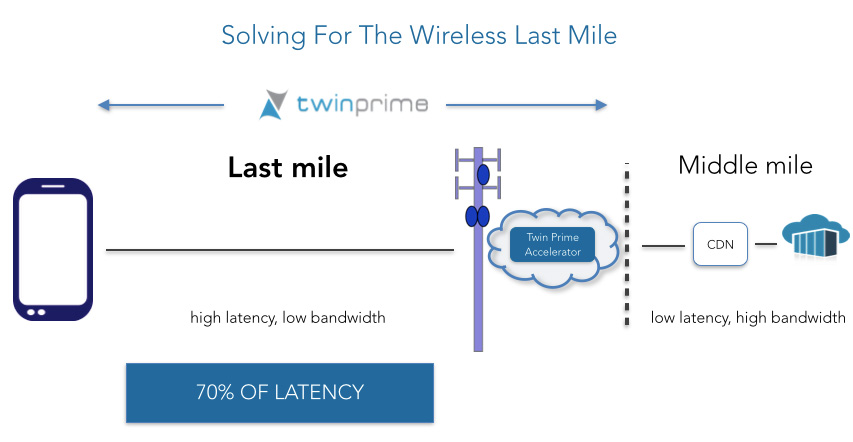
Twin Prime does not host, cache or distribute content. They also do not modify content or resize images or videos. As such, CDNs continue to be the place to distribute content and any other content engineering technology appears complementary to Twin Prime. When the bits and bytes for a particular piece of content is available, Twin Prime finds the most efficient way to request and deliver that data. In mobile almost 70% of end-to-end latency is spent in the wireless last mile, the link between the cell tower and the handset, where the company’s technology is focused. The following diagram illustrates how Twin Prime solution gets deployed with existing solutions like CDNs in tow.
tpTwin Prime’s technology solves the infinite variations in wireless networks by utilizing something they call an Automated Hypothesis Testing (AHT) framework, to achieve real-time selection and deployment of optimization strategies for each mobile session. Each optimization is customized to the specific wireless network characteristics and operating conditions including device, application architecture, network type, quality and location. The biggest insight I gained from them is the need for contextual optimizations, understanding how and where the mobile app is being used, and selecting and executing the right optimizations for that context. However, this is easier said than done. Mobile’s diversity throws up infinite contexts for which performance strategies have to be discovered and selected, which Twin Prime solves by using their AHT infrastructure.

Some might think this what traditional CDNs already offer, but most modern CDN performance solutions have been focused on the first mile latency challenges and helping organizations with content distribution, staging and scaling challenges. These technologies were shaped by the consistent nature of wireline Internet. These are solutions are static in nature and can be widely used without needing to how and where the app is being used. While these optimizations worked well for desktop, they fall short in the mobile world because of dynamic mobile operating conditions. CDN solutions continue to be valuable to enterprises today but do not solve the mobile performance problem.

Industry data shows that consumers spend more than three hours a day on their mobile devices, 90% of it on apps, and the apps are 3X slower than websites experienced on PC/desktops. Yet almost all these apps already use a CDN today, but the mobile slowness persists. This surely means that the root of the mobile performance problem lies elsewhere, which most current solutions don’t address.

What’s unique about mobile is its last mile with its ubiquitous volatility and diversity. The physics of the wireless link implies volatile and continually changing operating conditions including latency, bandwidth, losses, etc. Today there is enormous diversity in how we access data over mobile with 20,000+ device types, 1200+ different operators offering at least 25 different access technologies for 3G, LTE, Wi-Fi etc. The fact that we are mobile means that there are millions more factors tied to location and environment that come into play. The end result, in mobile almost 70% of the end-to-end latency is spent in the cellular last mile. That means, any solution to mobile performance has to start with a focus on last mile, which is where Twin Prime excels.

From spending some time with the Twin Prime team it’s clear they have a deep understanding of the constraints of the last mile, and the diversity in devices, carriers, locations in which mobile apps operate. They have built a mobile app acceleration solution that works for all kinds of mobile content and are laser focused on targeting a specific performance problem in the mobile market. Twin Prime says app developers and content owners can use their SDK to optimize their apps in a matter of minutes and already has paying customers. The company provider me with customer names already using their solution, but couldn’t disclose their names publicly as of yet.

Twin Prime is the kind of company I like keeping an eye on as they appear to have interesting technology, aren’t trying to replace or displace CDNs and are looking to solve a specific performance problem. Such focussed optimization solutions tend to get quick traction and awareness since content owners can see the immediate value proposition they provide. If you want to learn more about Twin Prime’s technology, they will be doing a presentation entitled “Optimizing And Customizing Content Delivery To Mobile Devices“, at the Content Delivery Summit in NYC on May 11th.

Compare Your Video CDN Pricing To The Industry Average

I’m doing my yearly survey on video CDN pricing from customers who used third-party content delivery networks. (ie: Akamai, Level 3, Limelight, Amazon, EdgeCast etc.) All results will be shared, free of charge, if you include your email at the end of the survey. I will also present the results in-person on May 11th at the Content Delivery Summit in NYC. Last year’s pricing survey data can be found at www.cdnpricing.com.

Please click below to take the 10 Question Survey

take-the-survey-button

Streaming Vendor News Recap For The Week Of March 23rd

Here’s a recap of all the announcements from streaming media vendors that I saw for the week of March 23rd. Lots of news leading up to NAB. A note to vendors, please stop with the silly “world’s first” langauge. Four releases this week used that phrase which is nothing more than marketing language. It’s not a term that customers care about or one that resonates with them.

Report: 29% Of Viewers Abandon Videos When They Encounter Quality Problems

A new consumer survey report from Conviva titled “How Consumers Judge Their Viewing Experience: The Business Implications of Sub-Par OTT Service” highlights the importance of video experience now that OTT has become a part of everyone’s everyday life. The report, which is based on the responses of 750 viewers ages 26-34, shows that 75% will abandon a sub-par video experience in 4 minutes or less. The worse news for content owners is that one in three are willing to jump amongst content owners if they’re not getting what they came for. Data also shows that 29% of users will close the video and try a different app/platform/website when they encounter a poor video experience.

Screen Shot 2015-03-26 at 11.06.38 PMSomewhat surprisingly, perhaps, the report shows that these viewers are more sophisticated in their judgments than we might be inclined to give them credit for. They clearly understand that a good experience isn’t just about avoiding buffering, but that it also includes a quick start to the content (what we call frustration time), and demands a good-looking picture.  For cord-cutters especially – and this particular survey sample is looking at a generation that almost certainly were watching on their parents’ cable subscription very recently – this is important, because they’re comparing what they watch both to other Internet services, and to the TV itself.

Screen Shot 2015-03-26 at 11.06.17 PMThe survey says that nearly half of them lose brand loyalty as soon as they get a bad experience. Whether that really plays out in real-time is debatable, but if it’s even half as bad as that, it’s a wake-up call for everyone: the quality of your video experience better compare favorably to the competition, or trouble could quickly ensue.

If there’s one big takeaway, it’s that holding the interest of today’s OTT viewers is hard, and getting harder. The proliferation of devices and platforms to be supported continues to accelerate, and the variation in quality between ISPs and CDNs is undeniable – and may be indecipherable, as it shifts and changes on practically a minute-to-minute basis. The survey shows respondents placing blame across the whole ecosystem when they get a lousy experience, but that’s small comfort to a provider whose expensive content is being abandoned.

Note: Conviva also publishes a very detailed report that measures the technical problems with streaming video when it comes to re-buffering, slow video startup, low-resolution and their impact on the viewer experience.

Pandora CIO To Keynote Infrastructure Event: Learn How They Have Scaled 50X In Eight Years

steve-ginsberg-headshot-smallI’m pleased to announce that Steve Ginsberg, CIO at Pandora has been added to the speaker lineup at our Content Delivery Summit, taking place May 11th in NYC. Partnering with Product Engineering, the Technical Operations team at Pandora has built and extended an efficient, resilient, high-volume architecture to keep the music playing, scaling it 50X in eight years. As our keynote speaker, Steve will share elements of design and insights from building the platform that brings music to millions. He’ll join Mike Dunkle from Valve’s network operations and infrastructure group as our two confirmed keynote speakers for the event.

Now in its seventh year, the Content Delivery Summit is the place to meet those who are building out some of the largest public and private CDN deployments to date. The summit also covers other web acceleration technologies including dynamic content delivery, transparent caching, app acceleration, QoS measurement, front-end optimization, mobile content acceleration and more. You can register for the event using the discount code of DR100 and get an all access ticket for only $395 if you register before April 11th.